Friday, July 14, 2006

Moi Contre Les Taupes

Forget the war on drugs. Forget the war on terror. There is a far more insidious enemy. He retreats deep into the darkness of the underworld where he carries out his dasterdly deeds, hidden from the sunshine where free men walk, well, freely. He cares not for flags or national anthems. He is not enlightened. He does not eat foie gras or drink wine. He is not of our race, creed, or color. He is taupe.
Picture from uk.safari.com

Actually, he is la taupe, which is French for mole. And he is digging in my garden. Or perhaps I should say they are digging in my garden, since I suspect there are more than one. I noticed the moles last year, toward the end of the gardening season. Apparently, they like the fact that my watering makes the soil soft and diggable. Suddenly great mounds (okay, not that great) of crumbled soil began to appear in the grass around the vegetable garden. We had moles!

I did some internet research and learned (once I refined my search to exclude the Mayo Clinic site that discussed the dark spots on your skin) that moles don't eat the roots of plants. Moles are carnivores. They eat grubs and other undground larvae-like things and don't pose any real threat to the gardener other than the unsightly mounds of dirt in the lawn. But what a mole will do is dig its running galeries right through the roots of a plant, potentially killing it or seriously impeding its ability to produce, say, tomatoes or eggplant or beans or peppers or whatever the plant is supposed to produce.

As long as the moles were on the edge of the garden I felt safe. But I was not safe. They became adventurous and daring. They thought, "This guy doesn't care about us, he does not see that we mean business, that we are not content to be relegated to the less productive lands." Actually, I don't know if they thought that, or even if they think. They're moles. But they moved on to other parts of the yard that were not watered, not soft. Soon we had mole hills that we could actually see from our windows. Arrrgh!

The war was declared. I did more research. Internet forums. Various remedies were suggested: moth balls, vinegar, ammonia, explosives (yes, little firecrackers that blow up in the tunnels), crossing your fingers and toes and eyes and spitting three times into the wind. Ok, I made that last one up, but you get the picture.

Then I started looking at gardening websites for environment-friendly ways of dealing with moles. They acknowledged that the some of the folk remedies were effective, but what they were effective at was moving the moles from one part of your yard to another. Ultimately, they said, the most effective and humane way to deal with unwanted moles (where do the wanted ones live?) is to trap them. Not trap as in trap-and-release, but trap as in kill. I was aghast, but I knew it to be true. I went to the hardware store, and sure enough, right next to the little explosives on the shelf were mole traps. They have little harpoons on them that pierce the little critter as it happlessly sets off the trap. Then there's the clean-up. Eeew.

So I bought one. I tried it. First, I had to identify a gallery that was actually being used by the moles. The galleries are not the hills of dirt, but are the tunnels just under the surface of the lawn that the moles use to get from the nest to the feeding grounds under your grass. You can kind of see them if you look closely. The hills of dirt are the results of deep excavations for nesting purposes. Those nests can be a few feet under your feet.

Back to the galleries: To know if they're being used, you are supposed to lightly tamp down a small section, thus blocking the tunnel, then come back the next day to see if it's been pushed back up. Too much work for me. Tamping, marking the spot, surveying over days, perhaps weeks. So I just picked a spot. To set the trap, you must dig out a section of the tunnel, place the trap inside, then put a bucket or something over the exposed trap-laden tunnel section to trick the mole into thinking nothing has happened. Yeah, right. Well, nothing is exactly what happened. I dug and set and dug and set for days. Not a single mole-kabob. I gave up. Winter came. The moles left on their own.

Then we got busy with this year's garden and I forgot all about moles. Forgot, that is, until that first hill appeared inside the garden, very close to my eggplant plants. Do moles hibernate? Were they there all along, or did they just come back, remembering what a good time they had here last year? No matter; they were here and digging.

One of my neighbors once told me that he took care of moles by opening up one of the hills and using the hose to flood the nest and galleries with water. When the little critters came up for air, he'd whack 'em on the head with a trowel (remember Whack-a-Mole at your local arcade?). I remembered this and decided I could do it. I got my trowel, my hose, and I dug. Found the hole and flooded it. Not only did no mole come up for air, but the water never topped off. I mean, the water just kept going and going and going. There might be a flood in China right now of my making! I tossed some small stones down the hole and covered it over with dirt.

There were no new hills for a few days. Did I drown the moles? Maybe. But then they were back. New hills in the garden. I did the flood'n'cover thing a few times more. But to no avail. I started to think that all I was doing was providing them with a little mole jaccuzzi. A quick bath then back to work. Dig, dig, dig.

So now I've resorted to more drastic measures. I went to the hardware store and... no, not the explosives. I bought some little poisonous smoke-bombs that you light, toss down the hole then cover it up. The bomb burns like a flare and the heavier-than-air smoke fills the galleries and the deep nest and supposedly asphyxiates the moles. I planted three of them this morning. There were two new hills, one of them right up through the roots of my newly transplanted rhubarb. I felt no remorse. Bring 'em on. Smoke 'em out. You're either with me or against me. Today is the 14th of July, Bastille Day, and I'm rising up in revolution. Let them eat cake, indeed. I want to eat rhubarb, dammit.

So here I sit, hoping that these smoke-bombs work. Not feeling the least bit sad that I'm trying to murder a colony of tiny, sweet, innocent moles who never really hurt anyone. And their young.


Thursday, July 13, 2006

Ah, Grasshopper...

... when you can snatch this pebble from my hand, it will be time for you to go.

This handsome critter showed up on the railing of our deck a few days ago. He just sat there, watching me as I watched him. Or her. I got the camera, snapped a few, and then he/she jumped away into the tree across the driveway. Comme ça.

Wednesday, July 12, 2006

Word Of The Week

Although it's not an original idea among expat bloggers, I've decided to introduce a new feature here at wcs. I very frequently find myself hearing a French word or a phrase that I don't know, or if I've heard it before, I'm not quite sure about its meaning. This can happen several times a day, depending on where I am and what I'm doing.

Once I learn a new French word or phrase, I start hearing it all the time, often two or three times in the few hours after I learned it. This makes me wonder what I thought was being said all the other times I heard the word but let it pass right by. It also makes me realize, as if I didn't already, how much of this language I don't know and how much there is to learn. I know that I can spend the rest of my life here and it won't be enough.

But I'm on my way. So with no further ado, the inaugural entry for Word Of The Week (look for a new word every Wednesday or so):

Butinage

A noun (masculine), from the verb butiner which means to visit flowers in order to extract pollen. This is, of course, what bees do in the garden.

I recently mixed up some insecticide for the vegetable garden (our mustard greens were being attacked and destroyed) and the cautions on the box included this: Eviter de traiter durant les périodes de butinage intense des abeilles.

I thought I understood the warning from the context, but I needed to look up butinage to be certain. I had guessed correctly. The caution means that you should avoid using the insecticide during periods of intense bee activity.

A bee peforming its "butinage" on runner bean blossoms in the garden.

By the way, the sources for my definitions will include the Petit Robert, the Robert & Collins French/English, and the Petit Larousse, among others. I use both hard cover and CDRom versions, reasonably up to date.

Tuesday, July 11, 2006

A Couple More

Just two more photos from Selles-sur-Cher before I move on...

The yellow postal cars and vans are ubiquitous in France. There's even a yellow postal TGV that speeds up and down the rails moving mail. Mail service in France is pretty darned good, by American standards. Letters go from town to town in one or two days. Here in the country, you get to know your local postal staff and vice versa. Especially the delivery person. Each year around holiday season, the postal carrier stops by to "sell" you a calendar, essentially collecting a tip. But it's a pleasure to "buy" the calendar since our carrier is so nice and takes care of us regarding packages, etc.

It's all wonderful, of course, until La Poste makes changes and your local staff moves to another town which is what happened here this month . Our small town post office's hours have been reduced, so the full-time staff was offered reduced hours (and reduced pay) to stay, or a transfer to maintain their positions and salaries. Both ladies transferred and we miss them. Now the whole town has to get to know a couple of new guys and start re-building relationships. Since the post office is also a bank, there are lot of people who go there quite regularly and rely on its being open to transact business; I've heard some grumblings about the reduced hours already. At least they didn't close the office altogether. We still seem to have our regular delivery person, however, so all is not new.

This is a close-up of the stone floor in the church at Selles-su-Cher.

Yesterday was very hot for us - over 29ºC (about 85ºF). We spent the morning working outside (gardening), had a lunch of pork chops and pasta with pesto sauce made from our own basil. We will have zucchini and yellow squash very soon (pictures coming!). In the afternoon we took naps and sat out on the deck not moving around very much. Today will be more of the same. In fact, the whole week is predicted to be hot with highs in the upper 20s C (mid 80s F). The humidity is very low, so it's not so bad, but there's no rain in sight. The drought continues.

Monday, July 10, 2006

That's The Way The Ballon Bounces

Last night was the big night. France vs. Italy. We had reservations with friends for a moules/frites feast in front of a big screen tv in the central place in Montrichard. It was very nice, we had fun, the food was great. But. France. Lost. Oh well, they played well, and only lost in the very end (being tied with Italy for most of the game after two very early goals). Zidane delivered a serious head-butt right in the chest of an opponent when said opponent held him back during a play late in the match. Words were exchanged; they must've been "fightin' words," then bam! They threw him out of the game for it, but I bet he enjoyed it.

And now for something completely different.

Stainless steel items in a hardware store window in Selles-sur-Cher. They just caught my eye. Above, a tea kettle. Below, thermos bottles.

Sunday, July 09, 2006

La Fromagerie

Selles-sur-Cher. "The cheese shop is open Tuesday to Saturday, from 9:00 a.m. to 12:30 p.m. and from 3:00 p.m. to 7:00 p.m., and Sundays from 9:30 a.m. to noon."

Saturday, July 08, 2006

Le Mont Saint Michel

Part Three : A Few Final Images

While impressive, the MSM is the most visited tourist attraction in France outside of Paris, or so I've heard. It certainly seems that way what with the throngs of people crowded into the narrow main street of the village. It's all very Disney-esque; there is store after store of postcards, tee-shirts, and kitsch. I heard english spoken nearly everywhere around me, along with a few other languages of the world.

A group of kids stomp their feet on the sand, bringing water up to the surface. It looked like they were having a great deal of fun.

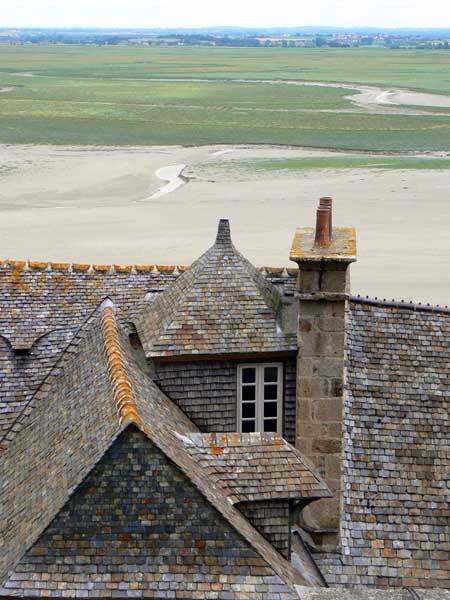
You can leave the main street and climb stairs here and there to find a view out between rooftops. The steep climb thins out a few of your fellow visitors, but not many.

A view out over the village rooftops.

I had been to the MSM once before, nearly 15 years ago. It was the middle of winter and the place was wet, cold, dark, and empty. I think I prefer it that way - it felt more real, if you know what I mean.

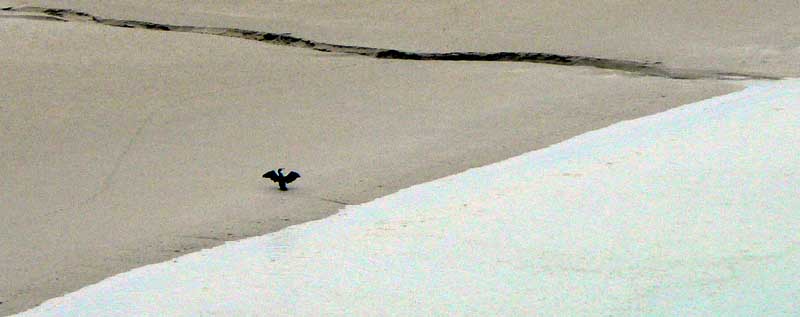
A bird stretches its wings on the exposed sands of the bay.

Another rooftop view.