Thursday, January 26, 2006

Tarte au citron


Today, I made a lemon tarte, tarte au citron in French. There are many types of recipes in France for the tarte au citron. Some are like the british/american lemon meringue pie. I made one of those last week and it was good. But the traditional french kind is very plain, if that's the right word. It's just a pie with a short lemon custard. The recipe I made today is a bit fancier. It has almond flour and crème fraiche, making the filling a bit more like custard than usual.

The ingredients: eggs, crème fraiche, sugar, almond flour, lemons.

First, I made a pâte brisée (this link will take you to my recipe; click the "back" button on your browser to get back here) and blind baked it.

The crust is "blind baked," meaning that it is pre-cooked with pie weights before the filling is added.

Next, the ingredients were eggs, lemon juice and lemon zest, ground almonds (or almond flour), and crème fraiche. I put strips of dough on top, but they sank into the lemon filling. Oh well.

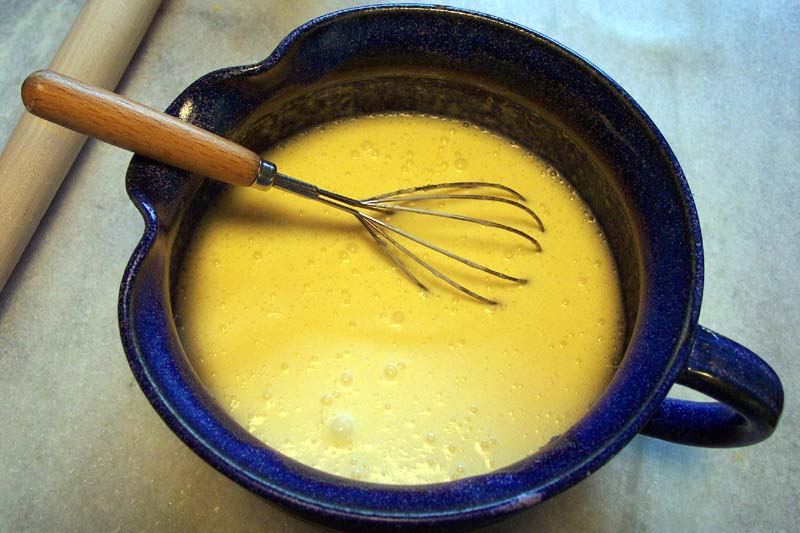
The batter, ready to go into the pre-baked crust.

It baked very nicely for about 20 to 25 minutes. And here's the result.


The pie is pretty, but the desired effect of crossing lines of crust didn't pan out. Most of the crust strips sank into the filling. Oh well, maybe next time! Bon appétit!

Tuesday, January 24, 2006

Photo du Jour : Fill 'er up !

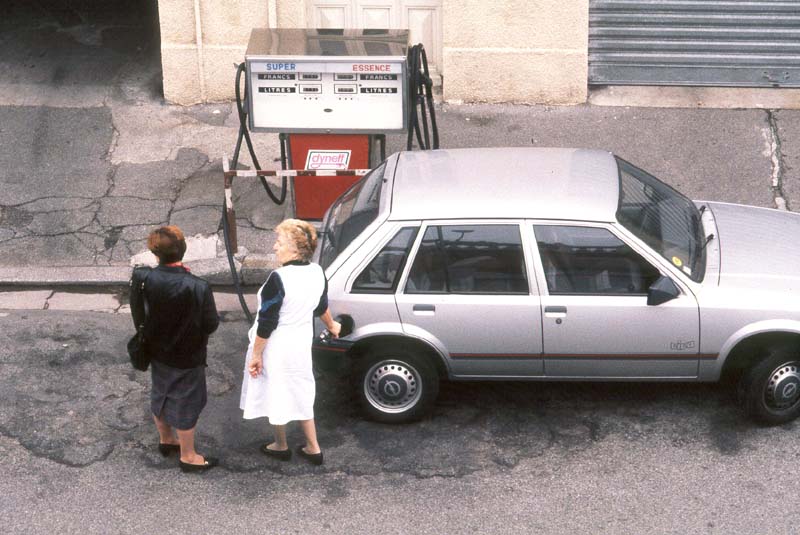
Or, in French, faites le plein. I took this shot in Toulouse, southern France, way back in 1989.

I don't remember what the women were looking at. By the way, this is not self-service; the woman with the white smock over her clothes is the gas station attendant. Gas stations in French cities typically have a pump or two on the sidewalk and drivers just pull up to the curb for service. Often there will be a service garage in the building where the pump is, with cars being worked on inside and probably a few floors of apartments above. In the suburbs and in the country, stations are more likely to resemble the American variety.

Look for the next in the series of Paris tours this weekend: Les Halles and the Marais.

Saturday, January 21, 2006

Tour 2: The Historic Axis

All city planners know the Champs-Elysées as one of the world’s great streets, but the street itself is only one part of a much larger urban axis that has taken form over centuries. Beginning in the central courtyard of the Louvre palace, the axis stretches over eight kilometers to the modern skyscraper suburb of La Défense to the northwest.

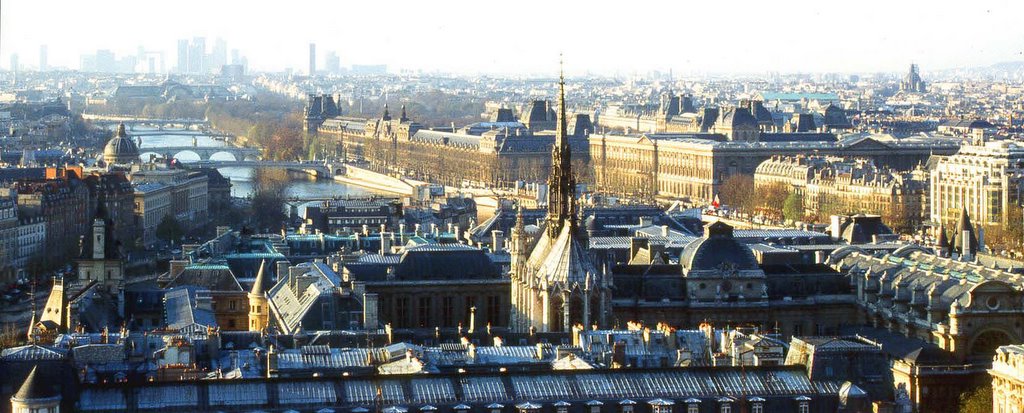
The Historic Axis stretches westward from the Louvre (center right) and Tuileries Garden along the Champs-Elysées to the Arc de Triomphe and beyond to the modern skyscapers of La Défense (upper left). This view is taken from the bell towers of Notre Dame Cathedral on the Ile de la Cité. The Saint Chapelle rises up in the center of the photo.

Start your walk at the Louvre/Rivoli métro station (corner of the rue de Rivoli and rue du Louvre in the 1er Arrondissement). Walk toward the river along the rue de L’Amiral Coligny. At the mid-point turn toward the massive eastern façade of the Louvre, cross the dry moat and pass into the Cour Carré (Square Courtyard). This is the starting point of the historic axis, which passes through numerous fountains, three triumphal arches, an ancient Egyptian obelisk, and one glass pyramid on its way west. The photo above shows part of the historic Colonnade on the eastern façade of the Louvre, the roof of the Pavillon de l'Horloge with the Obélisque, the Champs-Elysées and Arc de Triomphe in the background.

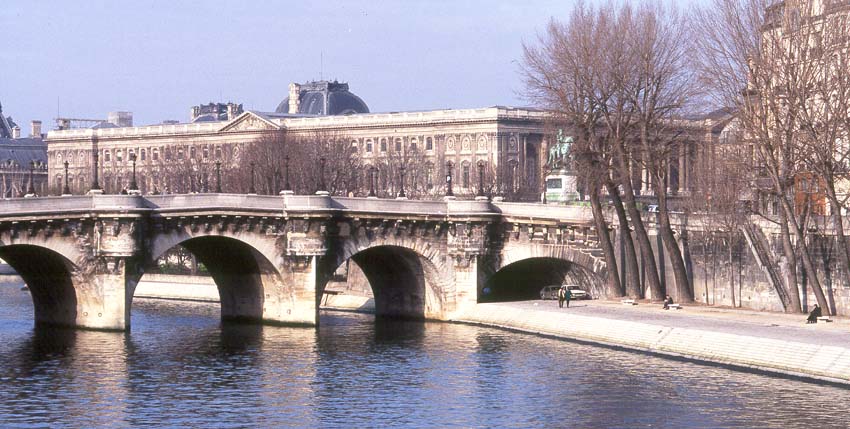
A view of the part of the Louvre that surrounds the Cour Carrée, or square courtyard, from across the Pont Neuf. This is the site of the original 13th Century medieval fortress.

The Louvre is one of the world’s largest art museums and is a world (and tour) unto itself. Take the time during your stay to visit at least part of the museum. Planners may delight in the exhibit that chronicles the history of the building itself and culminates in a subterranean walk around the foundations of the original Louvre castle built on the site in the 13th Century. Those foundations are beneath the southwest corner of the Cour Carré where you are standing at this point in the tour.

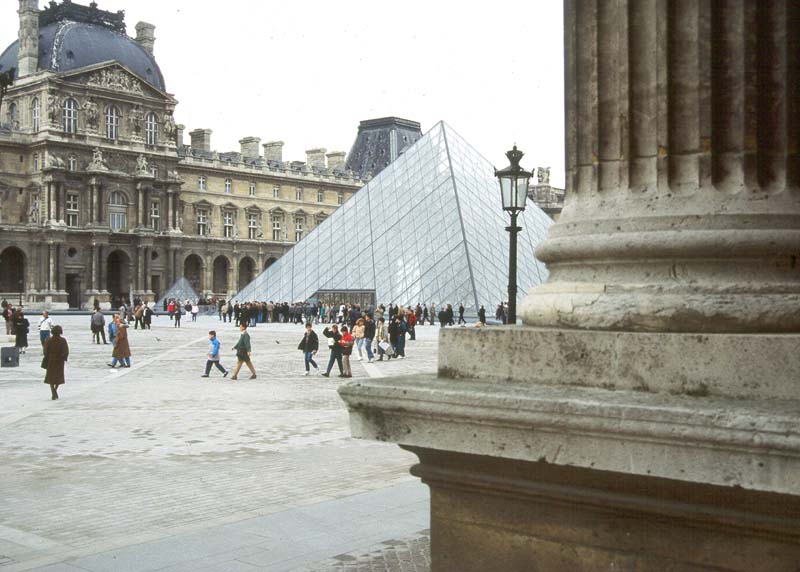
The Cour Napoléon and the Pyramid, which serve's as the museum's entrance.

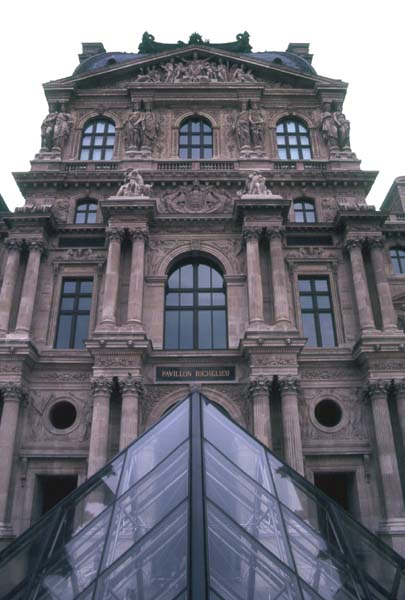
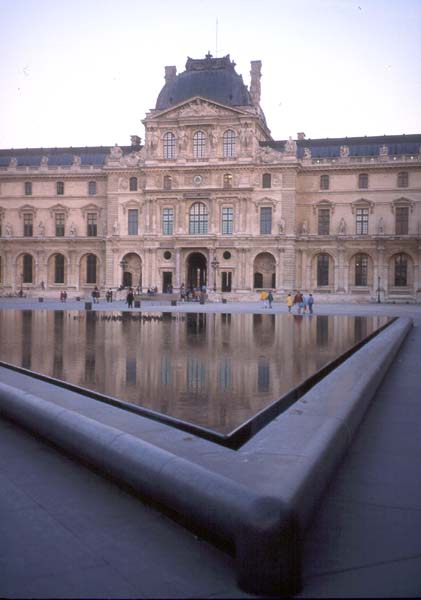
Continue westward and enter the Cour Napoléon, where you cannot miss I.M. Pei’s famous glass pyramid, opened in 1989. Walk around the courtyard and take in the contrasting views of the sleek glass and intricate stonework of the buildings. While the pyramid has been controversial, it successfully fulfills it charge to draw visitors into the courtyard and focus attention on the museum’s entrance (which was formerly a hard-to-find, inelegant door in the southeast corner of this courtyard, which also served as a parking lot for employees of the French Finance Ministry, once housed in the building). There is a fine café on the courtyard side of the Richelieu pavilion (pictured here).
From the pyramid, make your way west to the Arc de Triomphe du Carrousel, completed in 1808 to celebrate Napoleon’s military victories of 1805. The gardens, walkways, and the street that passes in front of the arch were renovated in the late 1980s as part of the Louvre modernization and expansion project. As you look again toward the west, the two extremities of the Louvre (the Pavillon de Marsan on the north and the Pavillon de Flore on the south) frame the view of the Tuileries gardens.

Another view of the Pyramid looking toward the Arc du Carrousel. The Tuileries gardens are behind.
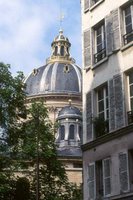
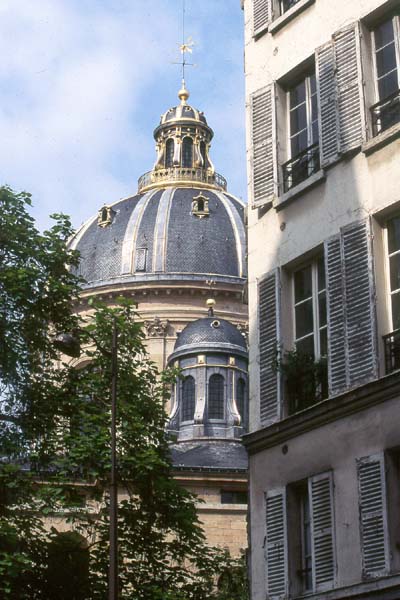
The space between these pavilions was once filled by the Tuileries palace, a free-standing palace begun under Catherine de Medici in the 16th Century. Over the next two hundred years the palace was incorporated into the expanding Louvre complex until it was destroyed during the French Revolution. Tuileries means “the place where tiles are made” and refers to supposed activities on this site prior to construction of the royal palaces. The photo in this paragraph is the dome of the French Academy (home of the Académie Française), on the left bank across the Pont des Arts from the Louvre.

Further to the west, walk into the Tuileries garden, a great example of a formal French palace garden. Its current form was designed by the French architect Le Nôtre in the 17th Century and includes classic parterres, tree-lined allées, fountains, terraces, and statuary. The garden, and others like it around the city, was once the royal court’s private playground. Now, of course, these magnificent green spaces are open to everyone and provide a relaxing escape from the frenetic street scene. On warm weekends, however, the gardens can feel more crowded and frenetic than the busiest parts of the city.
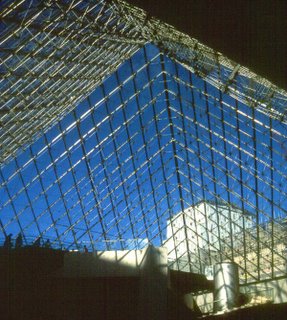
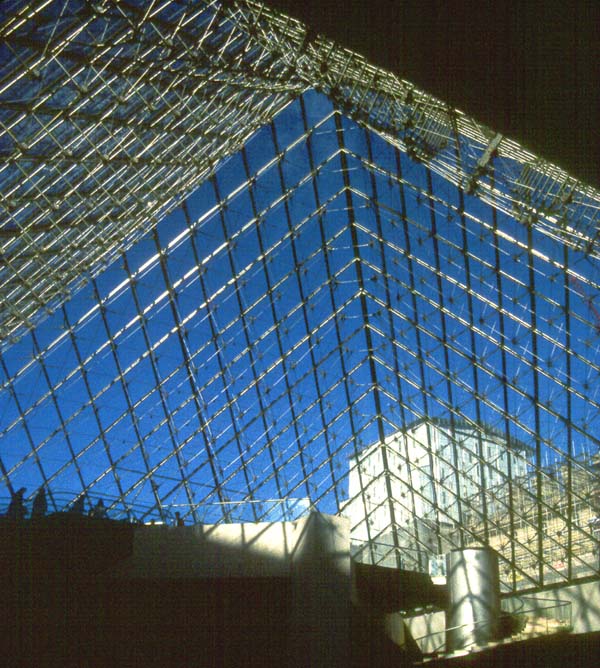
The view from inside the Louvre's entrance, under the glass pyramid.

An optional and interesting side trip from the Tuileries garden is up the rue de Castiglione to the Place Vendôme.

At the far west end of the Tuileries garden are two grand terraces, each with a long rectangular pavilion on it. The pavilion on the north side is the Jeu de Paume (the royal tennis court) which for many years housed the Louvre’s impressionist collection until its move to the Musée d’Orsay on the Left Bank. The building now houses contemporary art exhibits. On the south side is the Orangerie (where tropical plants spent cold winters), converted as well to an art museum.

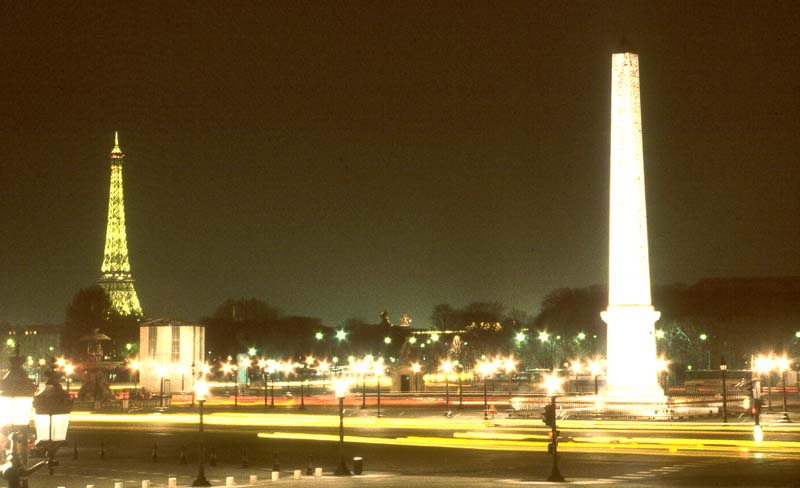
The Place de la Concorde at night. In the background, the Eiffel Tower rises up on the Left Bank to provide a counterpoint to the ancient Egyptian obelisk.

As you continue westward out of the garden, you will pass through, or more likely around, the Place de la Concorde. This grand 20 acre place began as a tribute to Louis XV, financed by local magistrates who commissioned an equestrian statue of the king for the site. During the revolution the statue was removed in favor of the guillotine and the square was renamed Place de la Révolution. In 1795 the name of the place changed to Concorde and today it handles a significant flow of automobile traffic.

It is worth making your way (carefully) to the center of the place where you will have an excellent view westward, up the Champs Elysées, toward the Arc de Triomphe and beyond to the Grande Arche de la Défense. To the right you can see the classical colonnade of the Madeleine church, and to the left, across the river, the façade of the French National Assembly (both worthy of visits).

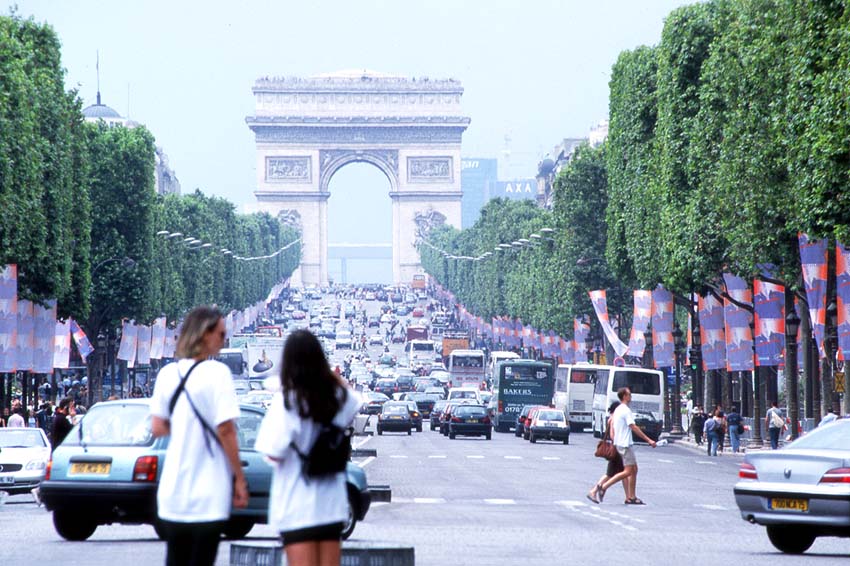
The Champs-Elysées. The Arc de Triomphe is dressed in bleu-blanc-rouge to mask scaffolding that surrounded the monument so the stone could be cleaned.

Also here in the center you will get an up-close view of the Obélisque, a gift to France from Egypt in the early 19th Century. The monument is over 3,000 years old and was originally installed in the city of Luxor. It is flanked by two grand fountains.

Around the place are eight statues named for cities in France (Rouen, Brest, Nantes, Bordeaux, Marseille, Lyon, Strasbourg, and Lille). If the center of the place represents Paris, then these statues mark the general direction from Paris of each of the eight cities. The United States embassy occupies the northwest corner of the place.
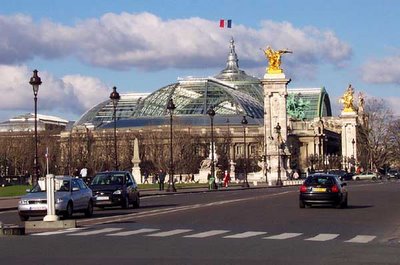
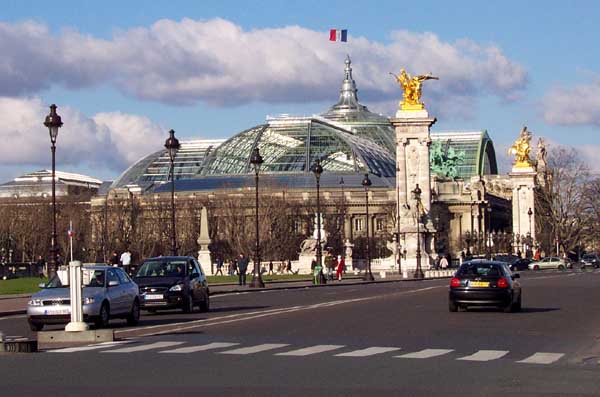
The recently restored glass roof of the Grand Palais glimmers in the sunshine. This view is from the Left Bank, across the Pont Alexandre III.

Once you’ve negotiated the place, continue your westward walk up the Champs Elysées through the leafy green park that flanks the avenue to the Rond Point des Champs Elysées. You will pass by the back side of the Elysée Palace on the right, the French presidential residence, and the Petit Palais and Grand Palais on the left. Built for the 1900 Universal Exposition, these two impressive buildings now house art and cultural exhibits and the Paris Beaux-Arts museum. The spectacular glass roof of the Grand Palais was recently restored to its sparkling glory. The Grand Palais’ rear wing is home to the Palais de la Découverte, a science and technology museum.

A few streets to the north and nearly parallel to the Avenue des Champs Elysées is the rue du Faubourg St. Honoré which is home to many designer boutiques and is a favorite shopping stop for many visitors. There you can also find the embassy of Great Britain.

From the Rond Point to the Place Charles de Gaulle, the Champs Elysées is lined with restaurants, stores, boutiques, offices and car dealerships. It can be a tourist mob scene; watch for pickpockets and high priced cafés. In winter, the avenue is magically decorated and lit for the holidays. In summer, it hosts the annual July 14th (Bastille Day) parade and serves as the end point of the famous Tour de France bicycle race. Recently this portion of the avenue was renovated to expand sidewalks, replace street trees and street furniture, and to generally make it more pedestrian friendly.

At the Place Charles de Gaulle, formerly the Place de l’Etoile, you can see one of the great elements of Baron Georges-Eugène Haussmann’s plan that transformed the city in the mid 19th Century. Haussmann served as the Prefect of the Seine under Napoleon III and directed all city planning activities. His team of architects and engineers cut wide boulevards through the medieval street pattern of the old city, updated the water supply and sewer systems, and created vast green spaces. He designed the étoile (star) of 12 avenues around the Arc de Triomphe and directed that the façades of the apartment buildings surrounding the place be uniform.
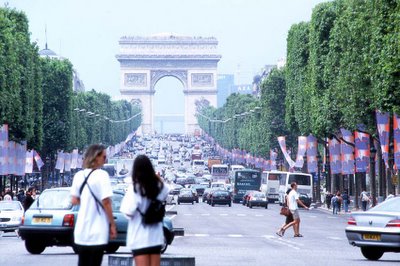
A closer view of the Arc de Triomphe, minus the scaffolding, and the Champs-Elysées. The faint horizontal bar seen in the center of the Arc is actually the roof of the 30-story Grand Arche de la Défense nearly 6 kilometers away to the west.

Today, the place is a swirling mix of street traffic and pedestrians. To get the Arc, use one of the underground passages; negotiating the place on foot is not advised! Three métro lines and one RER line intersect beneath the place, making it one of many primary transfer points in the city’s rail transit system.

The Arc itself is a monument to Napoleon’s war victories, memorialized in sculptures on each façade. Beneath the Arc is the flame marking the Tomb of the Unknown Soldier (WWI). Inside the Arc is a small museum with a great viewing platform at the top.

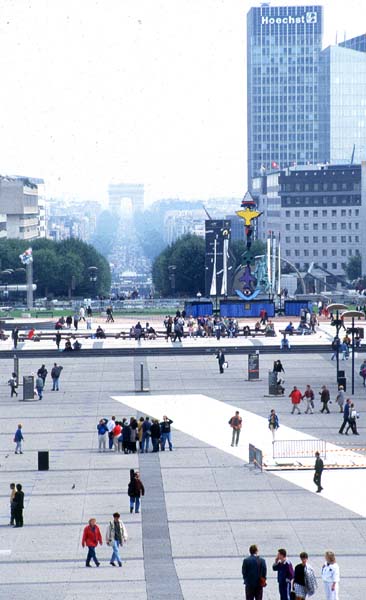
Beyond the Arc de Triomphe, at the end of the Avenue de la Grande Armée and across the bridge over the Seine, you can see the modern skyscrapers of La Défense and the current end-point of the historic axis: the Grande Arche de la Défense. The fastest way to get there is on the métro #1 or RER A lines from the Charles de Gaulle/Etoile station. At right, workers sandblast the roof of the C.N.I.T. at La Défense as part of the transformation from its original use as an exhibit hall to a modern office and retail complex.


Begun in the late 1960s, the over 300 acre development at la Défense is home to many French and international corporate offices, as well as hotels, residences, theaters, and shopping centers. The central axis, or esplanade, is for pedestrians (cars move around the development on a depressed ring road and trains run beneath) and features many fountains, small squares, and prolific public art. The neighborhood is named for a monument to the defense of Paris during the Prussian siege of 1870 (Franco-Prussian War); the monument was erected on the site in 1881 and can still be seen near the Agam Fountain on the esplanade.

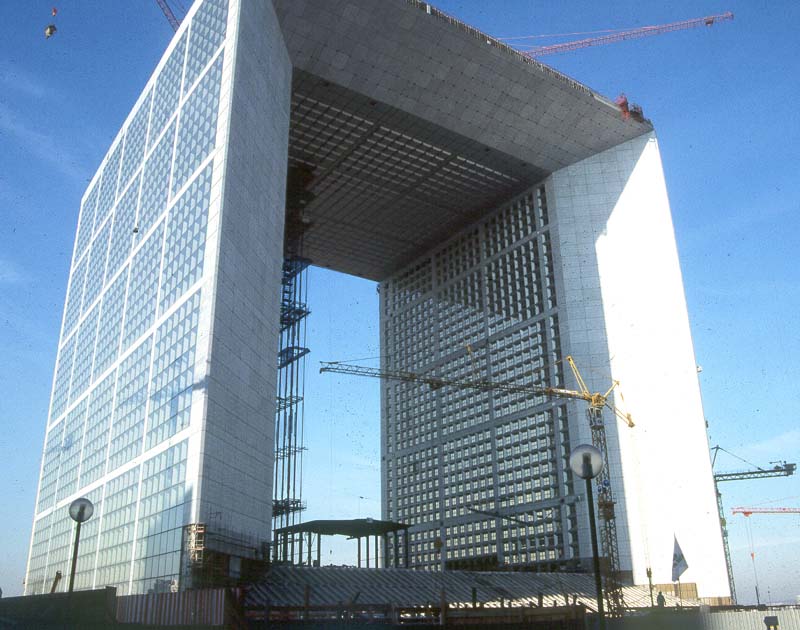
The Grande Arche, completed in 1989, is essentially an office building and includes a gallery and outdoor viewing platform at the top. On a clear day, the views of the whole of Paris from here are unforgettable.

The Grande Arche, seen here under construction in the 1980s. The cathedral of Notre Dame could actually fit in the space under the arch.

Where ever you end up, be it the Grand Arche or the Arc de Triomphe, returning to the starting point is a simple métro ride on the #1 line, or hop the RER A line for a quick trip back to the center of the city.

Another public art piece at La Défense, César's Thumb (le Pouce), created in 1965 by the artist César Basdannini.

Monday, January 16, 2006

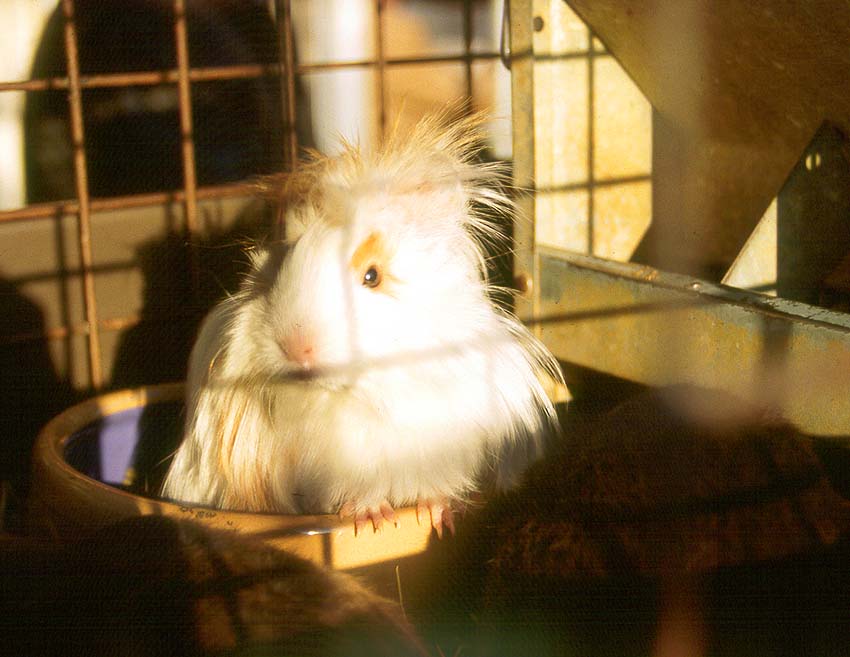
Photo du jour : Critter

I found this little critter outside a pet store on the Quai de la Mégisserie in Paris a number of years ago:

Look for the next in the series of Paris tours this coming weekend. The topic will be the Historic Axis from the Louvre to the Arc de Triomphe and beyond to La Défense.

Saturday, January 14, 2006

Tour 1: The Islands

The physical center of Paris is the cathedral of Notre Dame de Paris, the point from which all distances in France are measured. Notre Dame is on the Ile de la Cité, the larger of the two central islands in the Seine River. The Ile Saint Louis is the smaller one. Historically, there were about seven islands. Over time, people filled in the spaces between them creating the two islands we see today.

Start at Notre Dame Cathedral (the closest métro station is Cité, but St.-Michel is just across the river to the south). The building was begun in the 12th Century and is a glorious - though not the most spectacular - example of gothic architecture. For a fee, you can climb the bell towers for impressive views of Paris. On the square (parvis) in front of the cathedral is the entrance to the Crypte du Parvis, an underground archeological exhibit that includes foundations of 2000 year-old buildings on the site. This is the spot where Paris began as a reasonably secure fishing settlement prior to Roman expansion.

From the square, walk west, away from the cathedral (down river) along the Quai du Marché Neuf and the Quai des Orfèvres. The river will be on your left, and you will pass the Préfecture de Police and the Palais de Justice on your right. Many of the older buildings in these complexes were once the home of the French royal court, but they now serve as the center of Paris’s (and France’s) justice system. Of particular note is the Sainte-Chapelle (right), consecrated in the middle of the 13th Century, a marvelous example of the lightness of gothic architecture.

La Place Dauphine.

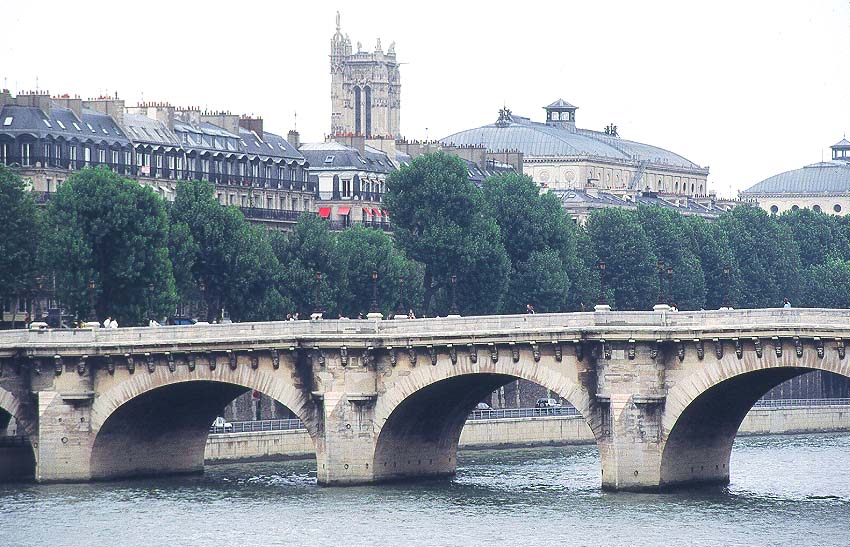
On the western side of the Palais de Justice, turn right up the rue de Harlay and into the intimate Place Dauphine. The triangular tree-studded place is formed by the Palais on the east and two angled rows of apartment buildings on the north and south. The residential place was developed in the early 17th Century under King Henri IV, whose equestrian statue can be seen just outside the place on the point of the island where the Pont Neuf connects to either bank of the Seine. Exit the place at the tip of the triangle, cross the street to the statue and take the stairs down to the Square du Vert Galant (a nickname for Henri IV), the small tree-shaded park on the island’s tip.

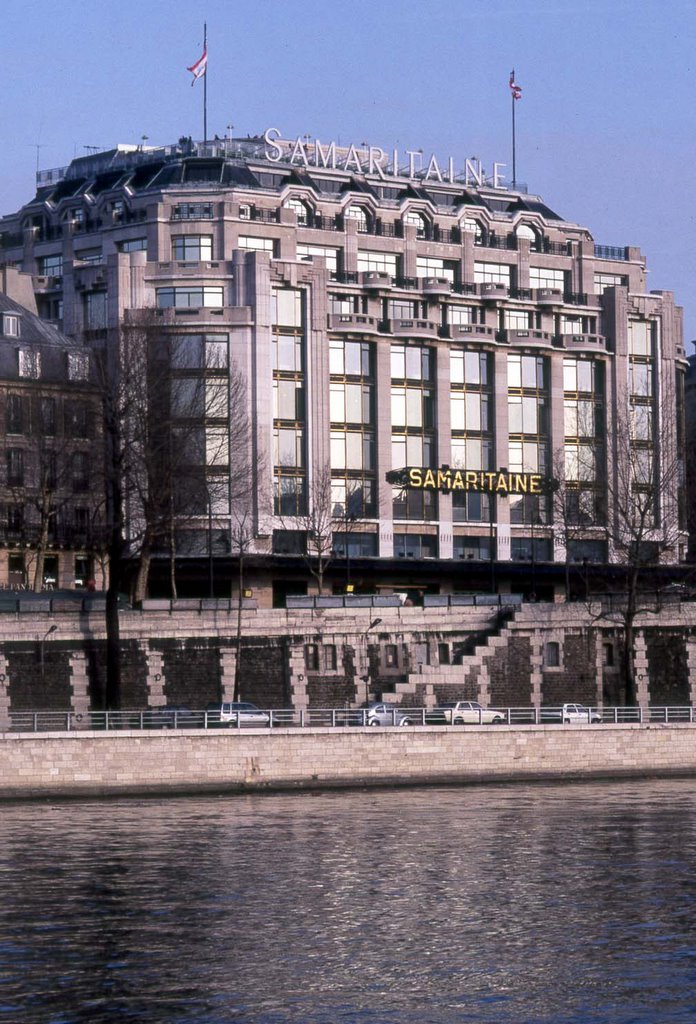
On the right bank you can see the Samaritaine, until recently one of Paris’s major department stores. It was closed in 2005 for business reasons that remain unclear. The store’s many buildings included a restaurant and a roof-top café that boasted great views from the center of town. The area around the Samaritaine is home to many other large stores, and along the rue de Rivoli just behind, countless shops and boutiques.

Looking down river, you will see the graceful steel arches of the Pont des Arts. In good weather, musicians and artists vie for space along this wonderful pedestrian bridge, which connects the French Institute building (home of the famed Académie Française) and the Louvre (part of which can be seen on the right side of the photo below). Completed in 1804, the Pont des Arts was the first cast-iron bridge to be built in Paris. It was irreparably damaged by a boat and closed in 1970. Fortunately, the bridge was rebuilt, this time in steel but exactly replicating the original, and re-opened in 1984.

Le Pont des Arts.

Return to the statue of Henri IV, cross the street and make your way to the north side of the island along the Quai de l’Horloge. You will now be headed up-river. On your right is the Conciergerie, part of the Palais de Justice complex that housed prisoners during the French Revolution, including, most famously, Marie Antoinnette.

The Tour St. Jacques and theaters at Châtelet.

As you continue around the Island, you can stop off at the flower market near the entrance to the Cité subway station. Across the Pont au Change you will see the Châtelet square and theater and the Tour St.-Jacques (above), the only remnant of the church of St.-Jacques-la-Boucherie. Across the Pont d’Arcole you will see Paris’ City Hall, the Hôtel de Ville, a renaissance style building constructed between the 15th and 17th Centuries. In winter, the square in front of the building hosts a public ice skating rink; various other activities, including demonstrations and protests, take place here throughout the year. An interesting fact: the Hôtel de Ville was the inspiration for the New York State Capitol in Albany.

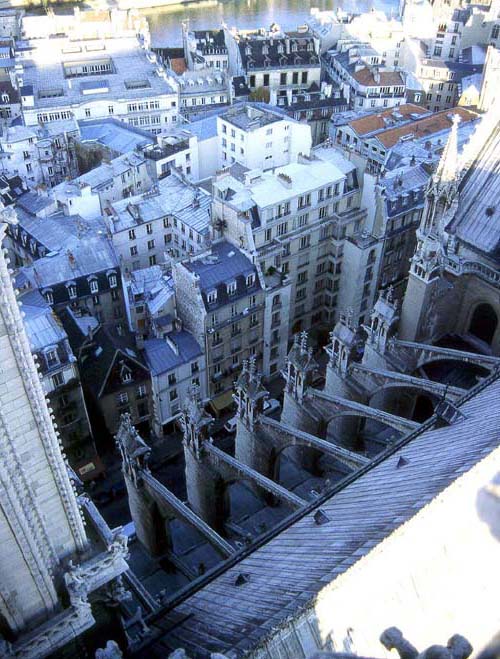
Along the Quai aux Fleurs you will have great views of the tip of the Ile St.-Louis. Continue along the river, or duck into the neighborhood on your right. The street that flanks the north side of the cathedral is full of souvenir shops and cafés and is often crowded with visitors. The Square Jean XXIII at the rear of the Notre Dame Cathedral offers great views of the flying buttresses that help support the building. Further east, at the up-river tip of the island, the small Square de l’île de France is home to an underground memorial to the two hundred thousand French Jews deported to Nazi camps during World War II.

Notre Dame's spire at left, Arab Institute in the center, Jussieu on the right.

From the square, look across the river toward the Left Bank and you can see the modern glass architecture of the Arab World Institute, founded in 1980. The Institute offers a library, a permanent exhibit of historic Islamic art and often hosts fascinating temporary exhibits. The dome of the Panthéon, while actually on the Left Bank, seems to rise above the square (photo at left, viewed from the Ile St.-Louis).

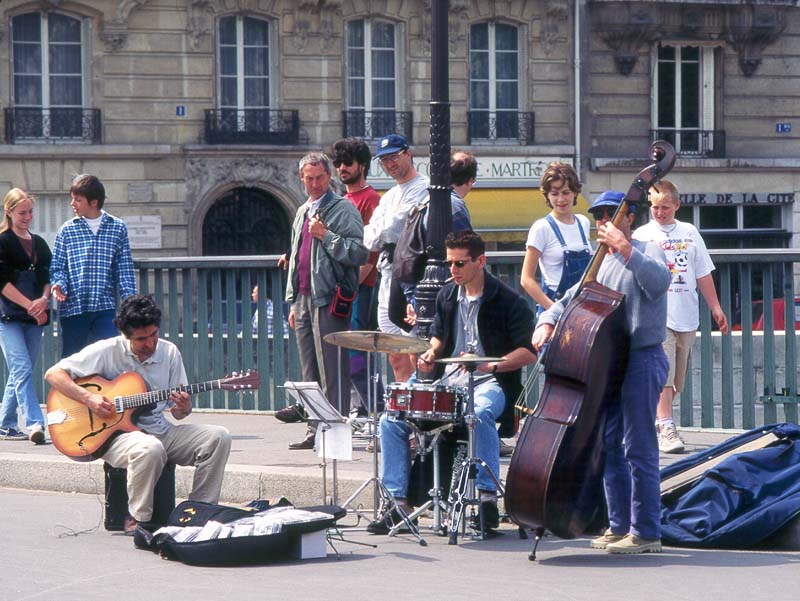
Musicians on the Pont St.-Louis.

Exit the square where you entered, turn right and make your way across the Pont St.-Louis, now a pedestrian-only bridge, to the second island. In good weather, the bridge and the square on the Ile St.-Louis are bustling with street performers. Around the square are several restaurants and cafés that fill the sidewalks with outdoor tables – a good lunch spot if you can nab a table. A favorite summer activity here is to stand in line for the delicious ice cream made by the Berthillon company. Enjoy a cone while walking around the island clockwise along the Quai de Bourbon.

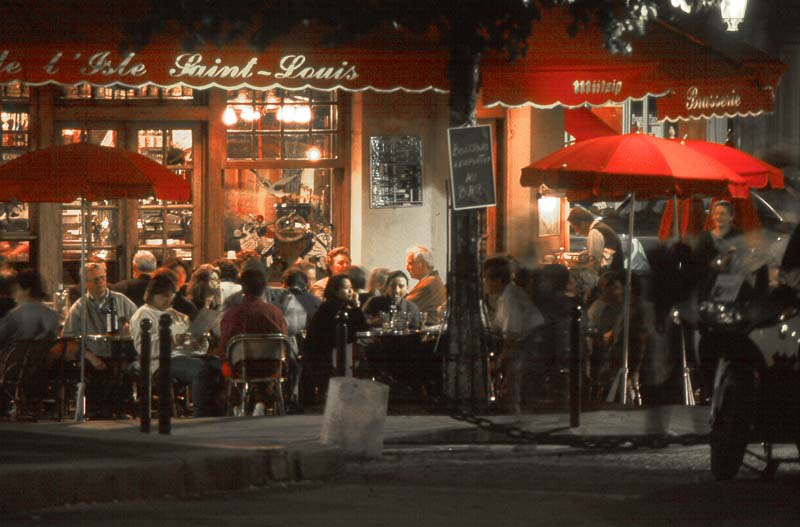
The Brasserie de l'Isle St.-Louis on a summer evening.

Keep an eye out for plaques on the houses commemorating famous architects, owners, or occupants. The Ile St.-Louis was originally developed in the mid 17th Century under King Louis XIII as an exclusive residential quarter for well-to-do businessmen and members of the royal court. Note the rectilinear street pattern on this small island.

Continue to the Pont de Sully, and then turn back into the island’s main central street, the rue St.-Louis en l’Ile, seen at right. Along this narrow but straight street you will find the 17th Century church of St.-Louis en l’Ile and many hotels, shops, and restaurants. Once back at the Pont St. Louis, you can return to your starting point on the Ile de la Cité or make your way to either the right or left bank for more walking.

Sunday, January 08, 2006

Paris : a collection of walking tours

This is the introduction to a series of walking tours of Paris that I wrote for my friend and former colleague, Andy Nash, for his International City Planners Network web site.
Paris was a favorite subject of mine as a student in both the undergraduate architecture and graduate city planning programs at the University of California at Berkeley. In 2004, Andy asked me to contribute to his site by developing a few walking tours of Paris that might be of interest to city planners around the world. I’ve written four tours to date and I’m pleased that Andy published them. Two remain to be written and, happily, Andy is not in a hurry.

After this introduction, I will post each individual tour here at about weekly intervals. The photographs on these pages are my own, taken over the past 20 years; most have been digitized from the original color slides. They don’t appear on the Planners Network web site. As always, click on a photo to see a larger version.
The first time I saw Paris was in 1981 when I arrived for a two-semester college language program. In those nine months I think I learned more about the city than I did about the language. Getting around was easy, whether by métro or on foot, and the variety of people, the incredible food on display everywhere, the profusion of public spaces filled with all manner of people, the art, the architecture, even the weather, overwhelmed my senses every day. I suppose I got used to this sensory overload in a way that allowed me to go to class every day and otherwise function on a regular schedule, but I don’t really think it’s possible for someone like me, not born and raised in Paris, to ever really get used to it.

I didn’t get the chance to return again until 1988, but since then I’ve been back at least once a year until 2003, when I moved to France permanently. No one person can communicate all that is Paris. It is so many things on so many levels. These tours are only a beginning.

The Ile de la Cité seen from the Pont du Carousel

PARIS: Introduction
The capital and largest city in France, Paris conjures images of romance, literature, gastronomy, art and architecture. Add to that a bit of palace intrigue, revolution, student rebellion, a strong labor movement and a wild political scene, and you have the ingredients for one of the most dynamic, and yet tradition-rich, cities in the world.

Paris has been evolving and re-inventing itself for more than two millennia. Early Gallic tribes in the centuries before the Roman invasion settled on what is now the Ile de la Cité and commanded river trade in the region. The Romans arrived in the first century, B.C., and expanded the settlement to the river’s left bank, to the area now known as the Latin Quarter. In the middle ages, as the Roman influence waned, the city re-grouped on the island before once again expanding to both banks of the Seine.

The 19th century saw great changes to the original fabric of the city as the famed Baron Haussmann cut wide boulevards through the tangled medieval web of streets. Having been spared destruction during WWII, Paris grew and evolved into the 21st century metropolis it is today.

The city’s great east-west axis extended outward to the modern skyscraper city of La Défense; socialist president François Mitterrand implemented decades-long modernization plans for the entire eastern sector of the city; the very center of Paris underwent a monumental urban renewal that continues today.

The City of Light (so named for the 18th century intellectual movement known as the Enlightenment) is full of examples of planning successes and failures. Seek them out and make up your own mind. The city’s roots run deep in religious, social, and political traditions, yet its citizens are not afraid to move their city ahead in bold new directions.

Paris is for lovers. A walk in the Luxembourg Gardens.

Paris is large and densely populated, so don’t try to see too much of it at once. Be sure that you have a good guide book or two. Many excellent guides are available in your local bookstores. Whichever one(s) you decide on, be sure it’s not too big or heavy to carry with you on your walks. Look for one with easy-to-read maps and some historical/architectural explanations; illustrations or photos really help you to get your bearings.

There are many tour operators that offer bus tours to the city’s main attractions; these can give you a fine overview of the place and most have on-off privileges (Paris L’OpenTour is just one example). Boat tours along the Seine can be quite crowded but can offer a unique perspective of the city (the largest operator is the Compagnie des Bateaux-Mouches).

However, the best way to see Paris is on foot. Pick a neighborhood and wander around. Don’t worry about getting lost; take frequent turns down small streets. Browse shop windows. Find an outdoor food market and watch what people buy. When you tire, sit down in a café and write postcards, make a journal entry, or just enjoy watching people. Remember that wherever you are in the city, a métro stop is not far away; you can always hop a train or a bus to get back to your place of origin.

The following tours are not comprehensive; they are starting points for discovering Paris on your own. There are very few paths in Paris that haven’t been trodden by countless visitors. Don’t obsess about seeing the “real” Paris. It’s all very real, from the finest museum collections to the kitschiest tourist traps, from the romantic out-of-the-way restaurants to the worn-down greasy spoons, from the meticulously maintained parks to the seedy red light districts; Paris has it all and then some. Bonne promenade!

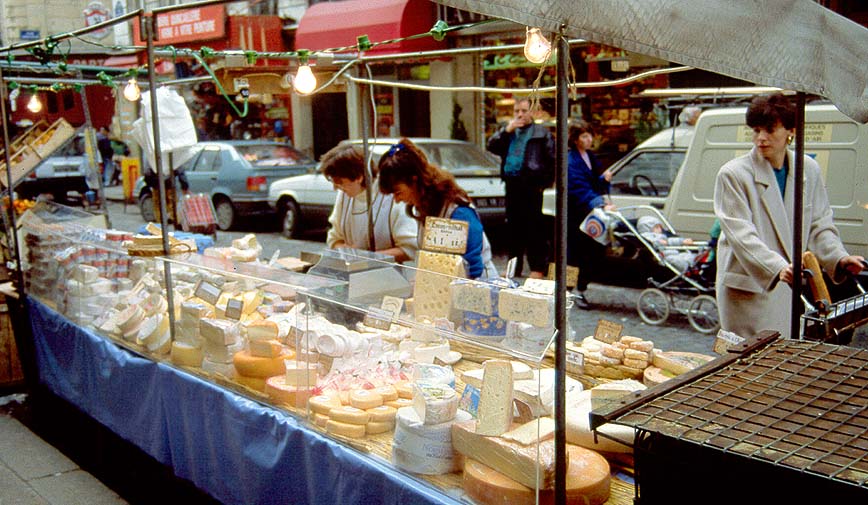
Cheese shop on the rue Montorgueil.

Tuesday, January 03, 2006

Pâte Brisée

The holidays are over and you made it through. The holiday meals were great, even though everyone ate too much. Not everybody saved room for pie. Those who did ate only the middle, leaving big hunks of pie crust on their plates like discarded pizza crusts. Even you noticed that the crust was a bit tough. You vow that next year will be different... but how?

A pie crust (pâte brisée in French) is easy to make.

I know people who are afraid to attempt a home made pie crust; I know others who think it’s too much trouble. Many of these fine folks – both in the US and in France – will purchase a frozen crust in the supermarket rather than attempt to make one from scratch. Some of the store-bought shells are okay, but what is the point of going to all the trouble to make a spectacular home made pie filling only to have it sit in a mediocre crust? Would you make your own crust and then pour in filling from a can? Okay, maybe you would. But still, there is something quite satisfying about making your own delicious pie with a tasty and flakey crust that your friends and family will savor. You may not do it every time, but you just might.

I know that people have been making, and not buying, pie crusts for centuries. They have not had, like us, the advice of countless celebrity chefs, the work-saving food processor or even exorbitantly priced baking lessons. They’ve done it in ridiculously small kitchens without fancy marble or granite countertops. They’ve done it while cooking three meals a day for hungry spouses and children. They’ve done it as part of everyday meal-making and not just for special occasions and holiday feasts. And, if they have done it, why can’t we? The answer is that we can. Making pie crust is basic; it’s easy and it’s worth the time it takes. No, really, it is.

Tarte aux prunes (plum tart)
I started making pie crusts in the late 70s when I had moved out my parents’ house and was learning to cook for myself. I remember that my grandmother’s apple pies were great, and even though I still got to eat them, I wanted to learn to make my own. I watched Gram when I could. She always used Crisco for her crusts, and my first crusts were laden with the white stuff as well. I tried to copy her technique, but she went very fast. For reasons I would only later learn, the crusts I made were heavy, not flakey like Gram’s, and baked into hard dome-shaped shells that required a jackhammer to puncture. The bottom crusts were soggy. They were flavorless and mostly inedible. After a few frustrating attempts, my pie making became a once-a-year event and the results were always the same.

Fast-forward a few years. I had spent a year in France and fell in love with tartes, the French fruit pies with only a bottom crust and beautifully arranged fruit on top. The crusts had flavor! These were not simple shells made to hold something tasty; they were tasty in their own right. I needed to learn how to make these.

After moving to California in the mid 80s, I tried again. I watched Julia Child, Martha Stewart and Jaques Pépin on television. I read recipe after recipe. I learned to add salt to the dough and I made the switch from Crisco to sweet, unsalted butter. The flavor was better but my crusts were as hard and brittle as ever. I was doing something wrong, but what?

I started to listen to what the chefs said about gluten. Webster’s New Universal Unabridged Dictionary defines gluten as: “a gray, sticky, nutritious substance, found in the flour of wheat and other grain, which gives dough its tough, elastic quality.” If not respected, the chefs said, gluten will make your dough hard and brittle. Aha! Gluten needs to rest, early and often. I experimented with letting the dough rest and, lo and behold, the pie crusts got flakier and tastier.

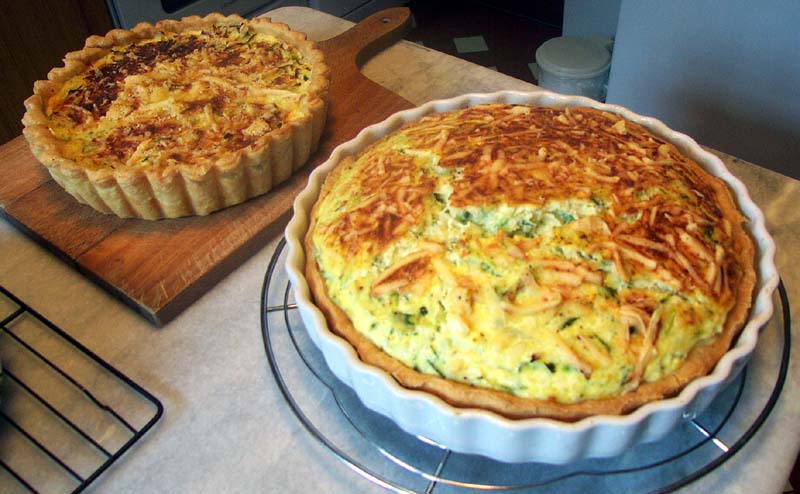
Quiches with grated zucchini and gruyère cheese.

Now, many years and pies later, I think I have it mastered. I make crusts much more frequently than I ever did. My pies get rave reviews, both the fillings and the crusts. I use my crust recipe to make both sweet (apple, pear, plum, pumpkin) and savory (quiche, meat, spinach) pies, and disappointments are few. I freeze leftover scraps of uncooked dough in freezer bags until there is enough for another pie. After thawing, there is no loss of quality. I’ve
even ventured into pâte feuilletée, puff pastry, but that’s another story.
Tarte aux courgettes (Zucchini pie)
Here we go:
The primary ingredient for a good pie crust is patience. You need time: time for the crust to rest between steps, time for the gluten you’ve activated to relax so your dough will not become tough. With the right amount of time and by keeping your butter and water cold, you can’t lose. Work the time into your schedule; you don’t have to make the pie all at once.

Here’s my basic recipe for a one-crust pie (see notes below for a two-crust pie):

Place a cupful of water in your freezer. Then, in a food processor, combine:

1 ¼ cups (about 180 g) of all purpose flour
¼ tsp salt or less, to taste
1 stick (¼ lb. or about 125 g) cold unsalted butter, cut into 8 or 10 small pieces

Process by pulsing at first, then full blast, until the butter is chopped finely into the flour. Don’t go too far, just enough so that the butter is still in pieces but evenly incorporated. This should take about 5 to 15 seconds. Next, continue to process while slowly adding:

About ¼ cup (about 50 ml) ice cold water (that you put in the freezer earlier)

until the mixture comes together and sticks loosely to the blade. This should take less than 10 seconds. You may need more or less water, depending on the day. This only means that it depends on the flour, moisture content of the butter, relative humidity and other factors that you can’t control and needn’t worry about. Just add cold water slowly until the dough comes together. If you add too much water, you will end up with a soggy mess, and a tough crust.
Take the dough out of the processor and place it on a floured sheet of wax paper. Lightly sprinkle the top of the dough with flour, press it into a disk shape, fold the wax paper around the dough and put it into the refrigerator for at least 30 minutes. This time gives the gluten in the dough a chance to rest and relax (become less tough) and gives you a chance to clean up or work on something else. At this stage the crust will wait for you, even until the next day.

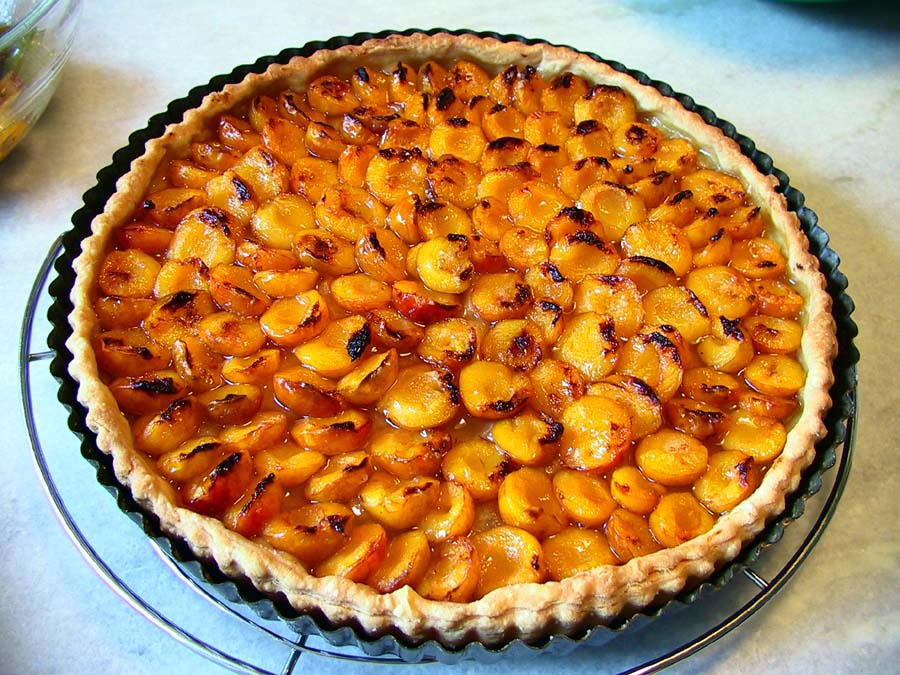
Tarte aux mirabelles (mirabelle plum tart; plums from the neighbors' yard)

After the dough has rested, take it out of the refrigerator and roll it out on a floured surface into the desired shape (if it’s been in there for more than a couple of hours, let it sit on the counter for about 5 minutes before rolling, but keep it cold; don’t let it get up to room temperature).

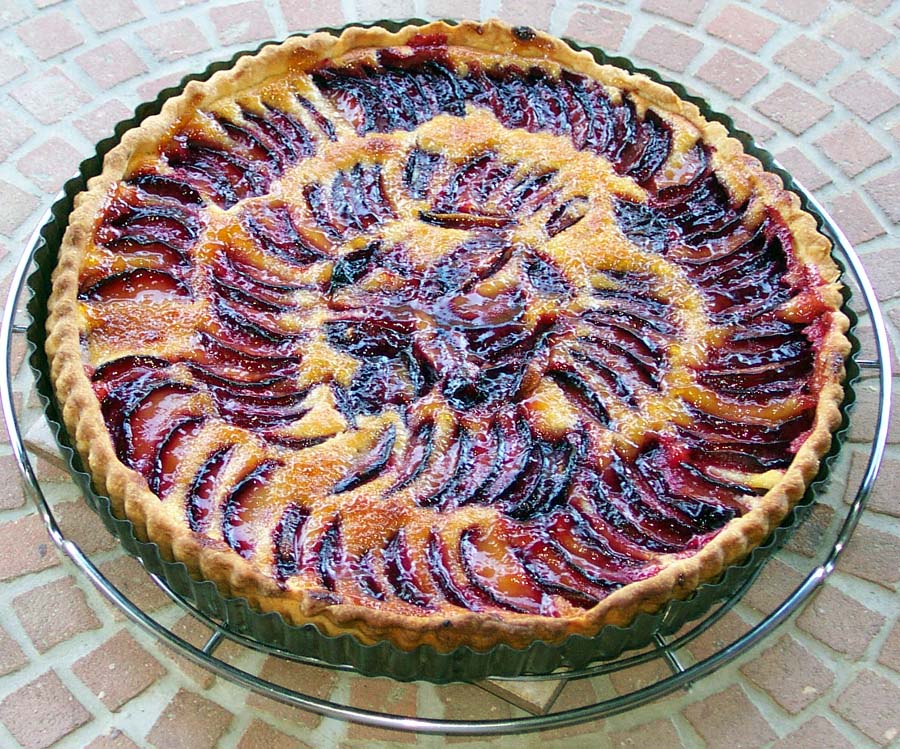
Tarte aux prunes (sliced plum tarte)
No matter what your pie recipe says, always put the dough in a buttered and floured pie plate, tart pan, or whatever you will bake it in. And always, after you line the pan with the dough, place the empty shell back in the refrigerator for at least 20 minutes before baking. Again, this lets the gluten in the dough rest and become less tough, keeps the butter cold, and gives you a chance to work on preparing the filling. It also gives you time to pre-heat the oven.

Blind-baking a one-crust pie/tart usually results in a crust that is crispier, flakier, and not soggy on the bottom. Blind-baking is easy. Cut a piece of kitchen parchment a bit larger than the diameter of your pie pan and fit it onto the crust covering the bottom and sides; the paper should be higher than the sides of the pie plate. Fill the parchment-covered crust with ceramic or metal pie weights, or dried beans, and then bake for 20 to 30 minutes at 350ºF, or 180ºC. Don’t let it get too brown at this stage. Let the crust cool a bit before removing the weights and paper. Then fill and bake again according to your recipe.

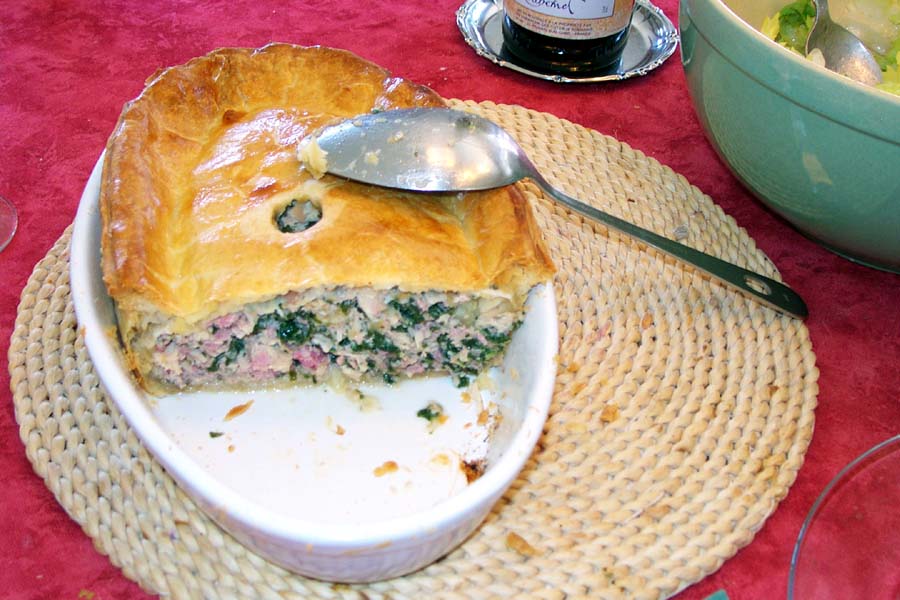
Tourte lorraine (veal and spinach pie)
Notes:
To make a two-crust pie, double the recipe. Freeze any left-over dough scraps for later use. There will always be left-over dough. Roll out the top crust after you’ve put the bottom crust in the fridge. Gently fold it into quarters and place it in waxed paper in the fridge to rest. When you’ve filled the pie, unfold the top crust onto the filling and seal. Don’t blind-bake the bottom of a 2 crust pie.
If you don’t have a food processor, pile the flour on your counter, cut in the butter, make a well and add the water a bit at a time. Mix and press with your hands until it comes together. It WILL come together.

Keep the butter and water cold. Refrigerate the crust between steps until it’s baked.

Click on any of the above photos for a larger view.