Showing posts with label french language. Show all posts

Tuesday, January 07, 2025

The little engine that could

This is the petit train (literally "little train") touristique that we took from St.-Trojan on Oléron to the beach I've been posting about. I looked up petit train on Wikipedia and found a surprise. This is not a petit train at all. It's a real, albeit small scale, train in that it runs on rails. A petit train, or tram in English, does not normally run on rails, but on a road surface, often in large parking lots (think Disney). I think the term petit train is commonly used for any small train or tram that carts tourists around. I don't think anyone would question the use of the term for this vehicle.

Choo-choo! Ile d'Oléron, May 2008.

As I feared, the landscaping crew canceled yesterday. The wind was just to much. They're coming back this morning and, although rain showers are predicted throughout the day, I think they'll be able to work.

I didn't make the king cake yesterday; we had a lot going on in the kitchen. But I plan to do it today. I'll try to remember to take some photos!

Thursday, December 29, 2022

Painting the house

In French, un(e) peintre is someone who paints. Like buildings, walls, fences, rooms, stuff like that. Someone who paints art is called un(e) artiste peintre. That's what my friend L. is. She painted this portrait of our house back in 2018. She's never been here, though. She painted it entirely from photos that I posted on the blog. Such talent!

Our house. The painting hangs in our guest room. Taken with the Pixel 6.

The wind gusted a lot over night and it's expected to get a little stronger as we move into the weekend. Yuck. I'm planning to go to the market on Saturday to pick up some things for our NYE meal of shellfish. We used to have oysters, but we're kind of off them these days. Gambas (prawns), coquilles St-Jaques (scallops), and maybe a langouste (spiny lobster) or langoustines (scampi, Norway lobsters, or Dublin Bay prawns) may show up on our plates.

Tuesday, February 08, 2022

Toilet humor

With our global economy, many of us around the world have become accustomed to product packaging and instructions provided in several, if not dozens, of languages. I'm guessing that a lot of the translations from the producers' language are done by computer. This can result in sometimes puzzling, sometimes hilarious translations.

Maybe it's different for other English speakers around the world, but in the US, the word "flush" is frequently associated with a bathroom fixture.

We found these Chinese noodles on a recent shopping trip. The cooking instructions in French are pretty clear, but the English is curious. "Cook the noodles in boiling water for about 4 minutes. Then flush the noodles and drain." Flush the noodles? In French it says to "rinse" the noodles, not to send them down the toilet.

I'll never forget many years ago when our friend, CHM, got a new George Foreman Grill, a kitchen appliance. The translation of the instructions into French had us rolling on the floor with laughter. Like the directions for cooking filet de semelle. In English it was fillet of sole, but in French, une semelle is the sole of a shoe. Mmm, tasty! Then there was the non-baton surface, in English: a non-stick surface. But the French word baton means stick, like the kind that falls from trees. There were many other funny translations. I'm sure I can't remember them all.

Saturday, January 29, 2022

Le plan

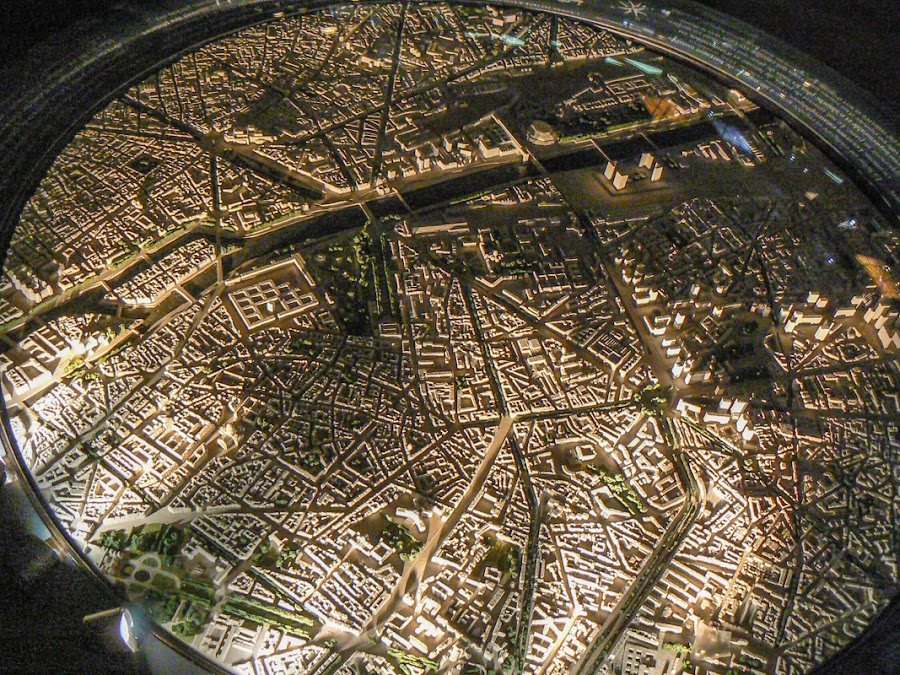
The photo of this scale model, un plan-relief, of a section of Paris is difficult to make out. I apologize for that, but I still think it's cool. It's part of a small collection of models that depict the area at different points in time, from before Paris was settled to the modern day. It is or was, I don't know if it's still there, a cool exhibit at the Muséum national d'Histoire naturelle (The National Natural History Museum). The model is focused on the area of Paris surrounding the museum.

Bad photo of a really cool model, Museum of Natural History, Paris, April 2009.

I can pick out several well-known monuments. Among them, the cathedral of Notre Dame, City Hall, the Place des Vosges, the Bastille Opera House, the Bercy Sports Center, and the Lyon train station on the islands and right bank. On the left bank I can see the Luxembourg Gardens, the Pantheon, the Jussieu campus (the subject of yesterday's post), the Arab World Institute, the Austerlitz train station, the Mitterand National Library and, of course, the Natural History Musem itself in the Jardin des Plantes.

Curious language tidbit: in French, a museum is called un musée (one of the few masculine nouns that end with a double "e"). A natural history museum is called un muséum. All muséums are musées, but not all musées are muséums. Go figure.

Thursday, January 13, 2022

Le petit déjeuner

Here's a typical breakfast served in French cafés and hotels. A croissant, a pain aux raisins or other pastry, a piece of baguette, butter, jam or jelly, honey, fruit juice or water, and coffee or tea. We Americans call this a "continental breakfast." I expect we got that name from the English, who traditionally eat much more hearty breakfasts.

A café table set up for le petit déjeuner, waiting for customers.

It was years before I realized the literal meanings of petit déjeuner (breakfast) and déjeuner (lunch). The verb jeûner means "to fast." The "fast" is the time between the last meal of the day and the first meal of the next day. When we have blood work done at the lab, they ask us to come in à jeun, meaning that we've fasted since the evening before the test. So, déjeuner means to de-fast or break your fast, hence "breakfast."

I've heard that, in the days before agriculture was modernized, farmers and other laborers would be up before dawn doing what they did. They'd come in at mid-morning for the first meal of the day: le déjeuner. It was probably more of a hearty meal, savory, and with wine or beer. As people left the farms and fields for work in the cities, a lighter meal was taken at the beginning of the day: le petit déjeuner (the little lunch). The more substantial déjeuner became the mid-day lunch. I don't know how much of that is true, but it sounds plausible.

And now I read (on Wikipedia) that in time of King François I (16th century), the members of his court attended mass at eight o'clock in the morning, and would take their first meal, le déjeuner, around ten a.m. With the rise of the aristocracy and bourgeoisie, by the 19th century it became fashionable to eat a light meal as soon as one rose in the morning. This petit déjeuner pushed le déjeuner to mid-day, followed later of course by le dîner (dinner) and even later by le souper (supper).

Now I'm hungry.

Sunday, July 18, 2021

Le massif de marguerites

Here's our daisy patch, now in full flower. I suppose it qualifies as un massif, building on yesterday's post. In English, we might call this a flower "bed." In Britain, flower beds are also called "borders," usually planted with many varieties of flowers and shrubs. As Judy commented yesterday, the French use the word parterre (literally, "on the ground"), although I associate that primarily with flower beds in very formal gardens like the Tuileries or at Versailles, for example. They also use the word plate-bande to designate a "border" or any narrow strip of ground planted in flowers or shrubs.

Like a drunk in a midnight choir.

So that's enough language for today! Yesterday's predicted high of 27ºC (about 80ºF) never materialized. We just barely made it above 20º (about 68ºF). The weather people still say we will hit 27º and 28º today and for the next few days. We shall see.

Saturday, July 17, 2021

Le jardin

Like the British, the French use the word jardin (garden) for what Americans call the "yard." A vegetable garden is un potager, a flower garden is un massif. In Britain, a yard is what we would call a courtyard, or une cour in French. So, this is a photo of le potager dans notre jardin.

Left to right: the vegetable garden, the oregano patch, the apple trees, and the grape vines.
De gauche à droite: le potager, le massif d'origan, les pommiers, et les vignes.

I took this photo a day or so after cutting the grass in the west and north forties last week. It's grown a lot since then. Time to mow!

Monday, March 01, 2021

Good knight

While not exactly shining, this is a suit of armure (armor) that was likely worn by a soldier in the late middle ages in France. I can't be certain, of course, because I don't have a photo of the description (visible on the base in front of the knight's left foot). It stands in the Royal Residence in Loches.

A late middle ages/early renaissance suit of armor. Loches, May 2006.

I think we Americans tend to think that all those who wore armor were knights, but as the British well know, the term "knight" is bestowed as an honorific title by a monarch, and not necessarily on a soldier. In France, the term chevalier refers to both a soldier on horseback (cheval means "horse") and the honorific title of "knight." At least that's what I glean from the Wikipedia articles on the subject. Perhaps the most famous of the historical knights were les chevaliers de la table ronde, the Knights of the Round Table of Arthurian legend. Modern day knights include the likes of Sir Alec Guinness, Sir Elton John, Sir Loin of Beef, and Sir Osis of Liver. Ok, those last two are from Loony Toons.

Monday, May 04, 2020

Show me a sign

Here's another of the photos I took in the Dordogne region of southwestern France back in 2006. It's a restaurant sign. Metal signs like this one, probably made of fer forgé (wrought iron), are common in the region. This one's in the city of Sarlat, a wonderfully preserved (and restored) medieval town that is normally bustling with tourists. I wonder what it's like now.

The King's Mill. I don't think we ate there.

One of the things I like about this image is the simple line drawing of the moulin (mill) on the restaurant's awning. The name of the restaurant, Le moulin du roy, means The King's Mill. A mill is where grains are ground into flour regardless of how it's powered. A wind-powered mill can be specifically referred to as un moulin à vent.

Saturday, May 02, 2020

Masques

I found this in our mailbox on Friday.

A note from the Mayor.

Here's my translation.

INFORMATION

Given the approaching deconfinement, I wish to inform you that the Municipality has ordered the fabrication of washable masks that will be distributed to you soon. You will therefore receive, free of charge, one mask per person.

I thank you for your civic mindedness during this complicated period of confinement, please remain vigilant in respecting social distancing practices.

Take good care of yourselves, cordially,
Annick GOINEAU
Mayor of Mareuil sur Cher

Wednesday, January 29, 2020

Nids-de-poule

Hens' nests. That's what potholes are called in French. The dirt road through the vineyards out back is rife with them. Every year they form and every year the town fills them in. Then they form again. I suppose that's no surprise given that it's a dirt road and is used by heavy equipment (tractors, harvesters, etc.). When it rains, the potholes become puddles. In winter they can freeze solid and I have to be careful not to slip on them.

How many hens made these nests?

Interestingly, most streets and roads in France (with the possible exception of some mountainous areas) are pothole-free. French winters are just not as harsh as, say, Chicago or Montréal winters with the constant freeze-thaw cycles that wreck paved streets. The French also have a reputation for maintaining their street and road network very well. That's not to say that there aren't "hens' nests" here and there, just that they're not all that common. Except in dirt roads.

Of course, I had to verify what the plural of nid-de-poule [nee-duh-pool] is. Compound expressions can be tricky, at least for me. Wikipedia says the plural is nids-de-poule, the literal translation being "nests of hen" or "hen's nests" which looks to me like many nests of one hen. Why not nids-de-poules or "hens' nests?" I don't know. There's no difference in pronunciation between the singular and the plural.

That got me thinking about the hen's (hens'?) eggs. Are the yolks called jaunes d'œuf (plural yolks but singular egg) or jaunes d'œufs (plural yolks, plural eggs)? I think officially it's the latter in French (unlike nids-de-poule), although I do hear both said. The "f" in the singular œuf is pronounced whereas the "f" and "s" in the plural œufs are not. I've never heard anyone say "eggs' yolks" in English. Comprend qui peut (understand if you can). Ain't language fun?

Sunday, October 20, 2019

Route barrée

Road closed. It's that sign we dread when we're in a hurry to get somewhere which, thankfully, isn't all that often these days. It's usually followed by a sign that says déviation (detour) and arrows that point the way. Funny, détour is a French word, but it's not used to mean detour in the American sense. The two words' meanings are subtly different.

Road signs and barriers stacked up behind the construction trailers behind our house.

Un détour isn't a temporary route around construction or other closure. It is, if I understand correctly, a curve or meander or simply another route that is just not the most direct way from point A to point B (as in the shortest distance between two points is a straight line). If you've used the famous Michelin touring guides in France, you might remember their rating system for sights: one star, intéressant (interesting); two stars, mérite le détour (worth going out of your way); three stars, vaut le voyage (worth the trip).

Monday, April 08, 2019

Église Saint-Michel d'Aiguilhe

The small town of Aiguilhe, just north of the center of Le Puy-en-Velay, is built around an ancient volcanic cone that has been exposed by millions of years of erosion. On top of the cone is a church named for Saint Michel. The church has been there in one form or another since the first century.

The church of Saint Michel in Aiguilhe, seen from a parking lot in Le Puy.

The name Aiguilhe is a local term for a pointed summit, resembling a needle. The modern French word for needle is aiguille, pronounced roughly ay-GWEE-yuh. I believe that the two words are pronounced the same.

Wednesday, March 20, 2019

Hope springs eternal

This is a spring up on the hill behind the house we rented in Le Puy-en-Velay a couple of weeks ago. It's quite a fancy setup, with two flows and stone basins to hold some of the water before it runs out to a stream. We saw a couple of similar springs around, all with the "non-potable, do not drink" symbol. I wonder what, if anything, the water is used for, or if the whole thing is just a remnant from another time.

Water springs forth from the ground in the volcanic hills around Le Puy.

A spring is une source in French. As opposed to spring, the season, which is le printemps. Or spring, the coiled bouncy thing, called un ressort.

Friday, August 31, 2018

Raisins on the vine

This is nature's way of making raisins. These wine grapes simply shriveled in this year's hot summer sun. And they're not alone. I see more burned grapes out in the vineyard this year than I've seen in recent years.

These are real sun made -- not sun maid -- raisins.

I guess these things go in cycles. The summer of 2003, our first in this house, was one of the hottest summers on record, significantly hotter than this year was. But I don't remember what the grapes looked like. I'm not sure I paid much attention that first year. I'll bet there were a lot of "raisins" out there.

By the way, the French word for grape is raisin. What we call raisins are called raisins secs (dried grapes) in France.

Monday, February 05, 2018

It didn't work

A few weeks ago, a town crew came through the vineyard on the dirt road behind our hamlet to fill potholes. They do this every year. But this year it seemed to be a little early. At any rate, they took a good hour and a half to do the job. They filled all the big depressions where water collects. The gravel mix they use compresses when vehicle tires run over them. This is what they look like now:

Tasha doesn't care about potholes (except to drink from them). She does care about field mice in the tall grass.

I suppose that all the rain we had in January was just too much for them. Maybe there wasn't enough time for the vehicles that use the road to pack the gravel down, and it stayed loose while it rained. Most of the "filled" potholes along the road look just like these. I wonder if the crews will be back to do it again come spring?

By the way, a pothole in France is called un nid de poule, a hen's nest.

Tuesday, November 14, 2017

Apple royalty

These apples are called Reine des reinettes in French and "King of the Pippins" in English. Curious. Why is it a queen in France, but a king in England? I did a little looking on line, but didn't find any answers. As far as I can tell, reinette should mean "little queen." But the word's origin is apparently disputed in French. Even so, reinette is used to describe dozens of related apple varieties, one of which is the queen of them all: la Reine des reinettes.

Six reine des reinettes apples, ready to be made into a pie.

Wikipedia says that the variety actually originated in Holland and was called kroon renet (crown reinette). It's all very confusing. In English, the word "pippin" comes from the French pépin (seed), so-named because the apple is apparently easily grown from seeds. The French Wikipedia entry says that the English call this variety "Queen of the Pippins" and that it's often confused with "King of the Pippins," but the English entry doesn't mention that at all. And they say it's a French variety, not Dutch.

Oh well. The apples are delicious (but not Delicious), whatever you call them. I made these into a pie on Sunday.

Wednesday, November 30, 2016

Chapeau !

When we hired the plumbing/heating contractor to work on the new shower stall, we included a few other items in the job. One was replacing a radiator with a towel warmer, another was to install a second outdoor spigot because the original one ended up inside the greenhouse. Also included was the installation of a cap on the chimney that comes up from the ventilation hood over the kitchen stove.

A chimney cap is called "un chapeau" (a hat) in French.

There are three chimneys on this, the south end of the house. One was for the central heating oil-fired boiler. That one is no longer in service with the new condensation boiler that vents through a new "hole" in the side of the house. The second is a twin to the stove hood chimney. I'm not sure why there are two in the kitchen; we think there may have been a coal burning heater in there next to the stove, but the second chimney is not in use. The third is the one connected to the current stove hood. Our wood-burning stove has its own capped chimney on the north end of the house.

We noticed last year, after a particularly hard rain event, that water seeped through the kitchen flue to the dry-wall where the stairs go up to the loft (close to the roof). We think that water got into the chimney, since they are open to the weather. So, the contractor sealed the two unused chimneys and added this cap to the third.

Wednesday, March 16, 2016

Tractor in stereo

I took a few photos of that stalled tractor out in the vineyard, so now you're stuck with them. I find it curious that the model is, apparently, a "507 Stereo." I've not heard of a stereophonic tractor before.

Mono tractors are so last century.

It's a German machine. Had it been French, I might understand the "stereo" thing. English words and phrases have a lot of cachet (see what I did there?) in French marketing these days. I often hear French products being touted as benefiting from "la French Touch." Oh, là là.

Thursday, November 05, 2015

On the forest floor

Well, woods is more like it. There are forests around, but we live among the vines, so we have patches of woods here and there. The bigger forests are not far. I can see part of the Forêt de Gros Bois across the river valley from us when I'm walking in the vineyard. The Forêt de Brouard is just to our south.

This mushroom is called amanite, and is quite toxic. Don't eat them!

Some of the patches of woods around us also have names. Closest to us is the Bois des Vaux where Callie and I sometimes walk. She's chased animals in there and that's where we encounter the stuffed clothing nailed to the trees. Spooky. I think that the difference between un bois and une forêt in French is pretty much the same as between woods and forest in English; it's a matter of size, the former being much smaller in area than the latter.

Be they woods or forests, they're not wild places but almost meticulously managed for wood. In forests, paths and roadways are well maintained and hunting blinds can be seen at regular intervals. Forests and woods are refuges for game like deer and wild boar. Except, of course, during hunting season.

Here's a case where an accent mark makes a difference. The word forêt, with the circonflexe over the "e" means forest. Without the circonflexe, it's foret which means drill bit. The words are pronounced exactly alike, your only clue to their difference being their gender: it's une forêt but un foret.