Wednesday, July 07, 2010

A vineyard tour

Every summer around the end of June, a big English tour bus arrives and parks behind our back gate. The door opens and a group of young students heads out into the vines as part of their tour of the Domaine de la Renaudie wine cellars.

The annual British invasion of the vineyard behind our house.

Patricia Denis, the wife of the winemaker and the woman who runs the business, leads the group out into the vines to show them how it all starts. I presume it's and end-of-school-year trip for these lucky students. This year they're a bit late, having arrived in early July.

Tuesday, July 06, 2010

In the mushroom caves

The tour lasted about an hour and the caves were a cool respite from the heat of the day. The tour guide was animated and she did all the explanations in English as well as French. There were quite a few anglophones on the tour with us. I'm glad my French is decent, however, because the guide's English was heavily accented and her translations were a bit off.

The processing plant and retail outlet for the local mushroom caves.

For example, she would translate grands chefs as "good cookers." In British English, a cooker is a stove. She also talked about mushrooms being sold in cans (tins if you're British), but the French word for cans is boîtes and it also means "box." So, she kept referring to mushrooms being sold in boxes. There were all kinds of little things like that in the English version of her tour which, coupled with her accent, made the English a bit difficult to understand.

One variety of mushrooms called le pied-bleu, or blue foot, for obvious reasons.

But I don't really think it mattered too much to the anglophones in the group. Everyone seemed to get the gist had a good time. Still, there was much more information in the French version of the tour. There are four or five varieties of mushroom grown in the caves at Bourré. We'd walk to where each variety was growing and stop for another installment of how mushrooms grow, how long it takes, how they're harvested (by hand), whether or not the mushrooms needed light (some yes and some no), and why some of the growth medium (composted and sterilized manure) was sitting directly on the ground while some was up off the ground in what looked like little bed frames (air circulation).

Our group standing around bales of compost with sprouting mushrooms.

And speaking of manure, the tour guide told us that the growth medium is used for only one batch of mushrooms before it is discarded. She said that the locals take the used compost for their gardens and that's why all the gardens in Bourré were so productive. Ken, not one to miss an opportunity, asked her when they gave it away and if anyone could get some. Yes, she said, but you have to live nearby. Well, I do, Ken told her. She said to just stop by any time to see if there was some available and they'd let him take it.

Champignons de Paris (button mushrooms) for sale in the boutique.

Free compost for the garden! And that's not just a load of...

Monday, July 05, 2010

Profiteroles

Cream puffs filled with ice cream and topped with chocolate sauce are a classic French dessert that has been popular in the United States for quite some time. I've made them once or twice since I learned that cream puffs are easy to make. The difference this time is that in addition to making the cream puffs, I also made the ice cream that fills them.

Cream puffs drying just prior to cutting off the tops.

Cream puffs start out as water (1 cup) and butter (about 75 grams) in a pot on the stove. Once they boil, flour is added (1 cup) and stirred over low heat until it forms a ball that separates from the sides of the pot. It cooks until it begins to dry out, then it cools for a short time. Eggs (four) are added one at time and stirred in. The dough goes into a pastry bag and is piped out into medium-sized balls. These get painted with an egg wash and after a short rest (about 20 minutes) are baked at 375ºF for about thirty minutes.

The puffs need to dry out, so after baking they sit in the oven, turned off and with the door ajar, for another twenty to thirty minutes. Then they're cut open at the top and any soft dough is scooped out (and eaten by the cook) leaving a completely hollow puff.

Assembled profiteroles with vanilla ice cream and chocolate sauce.

The puffs can be filled with whipped cream or ice cream. I made a simple vanilla ice cream (cream, sugar, eggs, vanilla) in our ice cream maker. Ken put together a tasty chocolate sauce using powdered cocoa. Three profiteroles on a plate is the usual serving. Delicious!

Sunday, July 04, 2010

Funky Feline Fotos

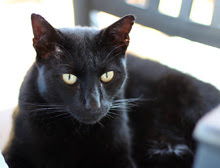
The heat of the recent couple of weeks has affected the animals a bit. They are very quiet during the day, taking refuge in the cool parts of the house. Callie spends most of the day in the utility room alternating from lying on a comfortable rug to lying on the cool concrete floor. Bertie has been spending his days in the garage napping.

Bertie, seen from our deck, in the neighbor's yard across the street.

Of course, Callie still gets her two walks a day. With the heat she's been not wanting to go far, preferring to turn back toward home before we finish our trip. Bertie, who doesn't get "walked," has been staying out at night wandering around. He's either hunting, exploring, or just hanging out at the Kit Kat Klub. But he's usually back home in the mornings, ready for his breakfast.

Something suddenly gets his attention...

After he eats, Bertie lounges around on his bed and accepts the occasional belly rub. Since his garage window is open, he's free to come and go as he likes. Every now and then we'll see him when he's out. He likes to nap at the top of our next-door neighbor's exterior stair. There's little traffic there in the afternoons and he can see our deck and keep an eye on us (and Callie). Sometimes we see him sauntering down the road. Other times he checks out the other neighbor's field across the street, as he's doing in this series of pictures.

...and he's off to check it out.

The two animals still won't hang out together. Callie still wants to chase Bertie when she sees him. But they can be in the same area together for a few minutes as long as we keep Callie under constant control. But one small lapse in our vigilance and she lunges for the cat. I think he prefers the wilds of the night to the company of the dog.

Saturday, July 03, 2010

Bats in the belfry

I was awakened this morning around one-thirty. I heard faint muffled noises. It was as if someone was walking up the stairs very, very slowly. The stairs are lined with cardboard right now to protect them until they're finished. At first I thought it was Callie trying to come up. Then I thought it was Ken. But why take one step every ten seconds? And he was in bed, anyway.

Light patterns on the ceiling of a cave gallery at the Monmousseau winery.

I got up and checked the stairwell. Empty. I went downstairs to find Callie sleeping. I even ventured down to see if Bertie was in the garage; he was still out gallivanting (I'll have to speak to him about that). I went back to bed convinced that I was hearing things. I was almost asleep when I heard the noise again. I got up to look, but it stopped, so I went back toward the bed. Then I felt a little breeze as something flew past my head. That's a pretty fast moth, I thought. I turned the light on and there it was. A bat was in the room.

It flew around the room and landed on a beam. Then it took off and did the same again. The noise I was hearing was the bat landing on the beam and repositioning itself for takeoff. By this time Ken was awake and was opening the windows wide as I was trying to guide the bat toward them. I started swinging a tee-shirt around to help move the bat in the right direction.

Then I hit him. Plop. He hit the floor. I scooped him up with the tee-shirt and tossed him out the window. But he didn't fly. Splat. I had visions of his vampire cousins coming for me in the night. But I managed to fall asleep and nearly forgot about him.

We found him dead on the balcony below the window this morning. Out of respect, I didn't take any photos before I disposed of the body. Poor little guy.

Friday, July 02, 2010

Disgorging

Dégorgement, in French, is the step in the sparkling wine making process that removes the sediments trapped in the neck of the bottle after riddling. The process is completely automated these days. At Monmousseau there is a series of machines that handle it all under human supervision. The first step after loading the bottles upside-down into the machines is freezing.

This machine pops the caps and catches the frozen sediments as they are forced out of the bottle.

The first machine freezes the neck of the bottle where the sediments have collected. The bottles are progressively moved through the freezing liquid by a long-armed robot that finishes by placing the bottles, rows of about fifteen at a time, upright onto a conveyor belt. From there the bottles are visually inspected by one of the winery's staff.

Video inspection of the wine level, cork, and cage.

Next, another machine removes the bottle cap. The pressure built up in the bottle during the fermentation step forces the frozen "plug" out. Invariably, some of the good wine goes out during this process. We saw another staff member with a little tube adding small amounts of wine back into the bottles at this point to ensure the level was consistent from bottle to bottle. In Champagne, what's added can actually be sweetened wine in a process called dosage. But at Monmousseau we were told that the bottles were topped off only with the same wine.

The section of the plant where bottles are labeled and packed for shipment.

Each bottle is then corked and secured with a capsule and wire cage. Another machine uses a video camera to check that the level of wine in the bottle is acceptable and to ensure the bottle is properly corked and caged. Then it's on to labeling and packing.

Thursday, July 01, 2010

Riddle me this

The Monmousseau winery specializes in sparkling wines made using the Champagne process, or méthode champenoise. Of course, French wine industry rules prohibit winemakers outside the Champagne region from using those words, so producers of sparkling wines in other regions use the words méthode traditionnelle to describe the process.

A hand-crank riddling machine at Monmousseau. Each cube or palette holds 520 bottles.

The sparkling wine process includes a second fermentation inside the bottle. Sugar and yeast are added to the still wine and the bottle is capped and stored on its side. The yeast consumes the sugar but its waste, carbon dioxide, cannot escape the bottle and stays dissolved in the wine. During this second fermentation, sediments (dead yeast) collect on the bottom of the bottle. These sediments need to be removed from the bottle before it can be corked and sold.

To move the sediments down to the neck of the bottle, wine makers would use special wooden racks that hold each bottle by the neck. A worker would turn each bottle one quarter turn daily and at the same time increase its angle slightly in the rack. This action, which takes considerable skill, would slowly move the sediments down toward the neck of the bottle until, about eight weeks later, they would all be collected at the cap. This is the process known as "riddling" or remuage in French.

These days, only very special bottles are riddled manually. Instead, large crates are turned using gears and cranks so that thousands of bottles can be riddled faster and with less effort (and skill). Many riddling machines are fully automated and require very little human intervention. The riddling process that once took skilled workers eight weeks can now be completed in a matter of days or even hours.