Friday, October 14, 2011

Bien dressé entre la nuit et la journée

There are a few places in Paris that can make you a bit nervous if you're driving a car. This is one of them: Place de la Concorde. This is the place where King Louis XVI lost his head. I suppose he got cut off. Rim shot.

The center of the Place de la Concorde. Click to concordinate.

In the center of the place is l'obélisque, a gift to France from Egypt in 1836. It is one of a pair of obelisks originally placed together in the city of Luxor and is well over three thousand years old. In its current setting, it supposedly serves as a sundial with lines marked in the pavement around it; I've never noticed the lines. The obelisk is flanked by two large fountains: the Fountain of the Seas and the Fountain of the Rivers, each meant to celebrate France's naval prowess. If you're brave enough to make your way on foot to the middle of the place, you can see engravings on the base of the obelisk that depict its transport from Egypt to France.

The two impressive buildings on either side of this picture are, on the left, the Hotel de Crillon, a classy high-end hotel, and on the right, the headquarters of the French Navy. Between them, at the top of the rue Royale, you can see the classical façade of the Madeleine Church.

The Hotel de Crillon is getting a face lift. That façade on the left (with the red ribbon) is actually a painting on the screens that hide the workmen's scaffolding. Just to the left, out of the photo, is the Embassy of the United States.

About a half-hour before I was to meet Mark and Julie at the Rodin museum, I noticed that my camera battery was losing power. My second battery was back at the hotel room. I decided I had enough time to get to a subway station, go to the hotel and get the battery, then take the subway back to the museum. I was on my way to the subway when I took these photos.

Thursday, October 13, 2011

Marie-Joseph Paul Yves Roch Gilbert du Motier

Marquis de La Fayette. One of the countless statues honoring this French hero of the American Revolution stands in the Cours de la Reine on Paris' right bank. It's a life-size (maybe bigger) equestrian statue on a very tall pedestal.

The Marquis de La Fayette in Paris.

The Marquis de La Fayette visited all of the states of the new American nation before his death in 1834. In 1778, during the Revolutionary War, he came to my home town of Albany, New York, to lead a proposed invasion of Canada. The invasion never took place, partly because La Fayette had concerns about troop numbers and the logistics of the invasion.

While in Albany, La Fayette stayed at a house called Cherry Hill, which is still standing and operates as a historical museum. I remember going there as an elementary school student and seeing an exhibit that included a pair of La Fayette's silk stockings, apparently left behind after his visit.

A downtown park in Albany, located next to the state capitol, is named for the Marquis. Lafayette Park and Historic District include the park itself and many of the surrounding buildings.

In the US, I've seen the Marquis' name spelled with a space (La Fayette), with no space and a capital "F" (LaFayette), and with no space and a small "f" (Lafayette) .

Wednesday, October 12, 2011

Les bateaux-moches

That's what my friend and frequent commenter CHM calls them. It means "the ugly boats" and is a play on their actual name, les Bateaux-Mouches. The name (literally "fly boats") is derived from the neighborhood in Lyon (le quartier de la Mouche) where a certain number of the boats were built as passenger transports for the Paris Universal Exposition in 1867.

The upper deck of the bateau-mouche "l'Hirondelle." The lower deck is usually glassed in and heated in cold weather.

This particular style of boat was used since earlier in the nineteenth century to transport freight or passengers along rivers and canals in France, but it wasn't until about 1950 that one of those boats built for the 1867 expo was used in a new venture: taking people on pleasure cruises up and down the Seine. The name "bateaux-mouches" was registered as a trademark and the business thrived, as it does today.

The sign above the ticket office.

I've taken these cruises a few times over the years. They're really nice, day or night, especially when it's warm and you can be outside on the upper deck. There are all kinds of cruises available these days, including dinner cruises. There are also several other companies that offer similar cruises on the river, but I think the Bateaux-Mouches is the most well known.

Tuesday, October 11, 2011

Zouave et sophistiqué

This statue adorns the upstream end of one of the pillars (close to the right bank) on the Alma Bridge over the Seine in Paris. It is the only one remaining of the original four military statues on the bridge and depicts a zouave soldier of the Crimean War in his battle garb.

Looking down on the zouave. He's wearing a fez, and his feet are dry.

The zouaves were infantry units in the French African Army whose first campaign was the conquest of Algeria in the nineteenth century. They were active in many battles and wars beyond north Africa until 1962; their units were dissolved when Algeria gained its independence from France.

The peculiarity of this particular statue is that it was once a measure of the Seine's flooding. When the zouave had les pieds au sec (dry feet), the Seine was below flood stage and all was normal. If the zouave had les pieds dans l'eau (it's feet in the water), the Seine was at flood stage and the roadways, parking lots, and walkways at water level were inundated. When the river's level got up to the zouave's thighs, boats could no longer navigate (they couldn't get under the bridges). During the historic flood of 1910, the water rose up to the zouave's shoulders.

Parisians looked to the zouave during periods of high water until the early 1970s, when the bridge was reconstructed with only one pillar actually in the water. The three companion statues (a foot soldier, a grenadier, and an artillery man) were removed from the bridge and located elsewhere. The zouave remained on the bridge, but was moved and placed higher up than it was originally.

Monday, October 10, 2011

La Seine

This view of the Seine is looking up river from the Pont de l'Alma. There is kind of an optical illusion going on here: the bridge you can see spanning the river is the Pont des Invalides, but just beyond it is another bridge with gold statues at either end. That's the Pont Alexandre III. In this photo you might mistake them for one bridge.

Looking up the Seine toward the Louvre, part of which is visible on the right. Click to fleuvinate.

On the left, at water level, you can see the departure point for the famous Bateaux Mouches, the tour boats that cruise up and down the river daily. After dark, the boats' bright lights illuminate the buildings on either side of the river.

Also on the left (which is the Right Bank because it's on your right-hand side as you look down river), you can see the recently renovated glass roof of the Grand Palais, a museum and exhibition hall built for the Universal Exposition of 1900.

The Seine is classified as une fleuve in French, which means that it's a river that runs into the sea. Other principal French fleuves include the Loire (the longest in France), the Rhône, and the Garonne. Rivers that are tributaries to other rivers are called rivières. We live on the Cher, which is une rivière because it's a tributary of the Loire.

Sunday, October 09, 2011

Un aperçu

After my refreshing drink, I headed out again to look for some lunch. I walked along the rue Saint Dominique looking at restaurant menus, but nothing spoke to me. Until I got to the end of the street. There was an old favorite: le Champ de Mars, a great café very close to the Eiffel Tower. The terrace was sunny and the umbrellas were out. I sat down.

The Eiffel Tower seen from the Avenue Rapp.

Lunch was a big mixed salad and some nicely chilled white wine. Yum. After lunch I still had time for more walking before meeting my cousin Mark and Julie at the Rodin museum. I decided to head up to the river on the Avenue Rapp and walk back toward the Esplanade des Invalides. On my way I was treated to glimpses of the tower rising up above the buildings.

Saturday, October 08, 2011

La pause rafraichissante

I started my walk earlier in the morning over in the fifth arrondissement and now I found myself in the heart of the seventh, a healthy four kilometers (about two and a half miles) from my starting point. The day was turning hot and I was thirsty. I made my way through the rue St. Dominique to a café I know on the boulevard de la Tour Maubourg.

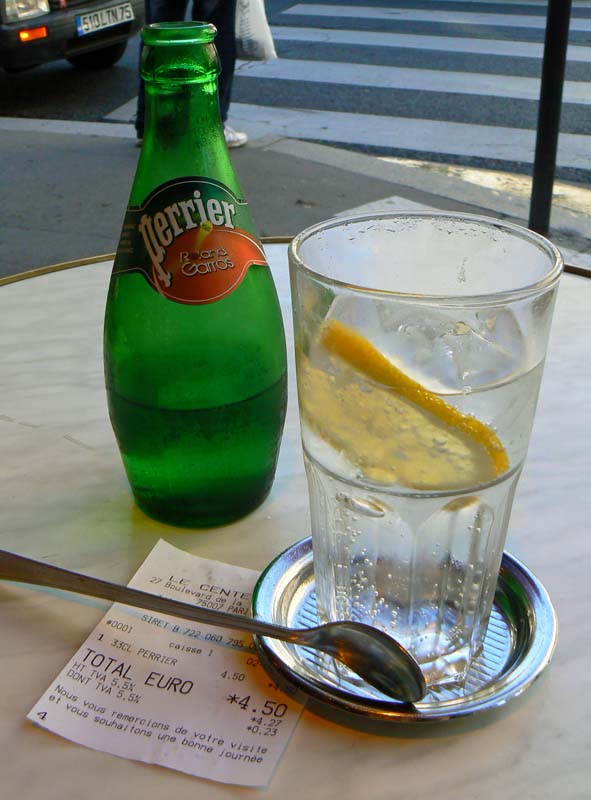
The pause that refreshes. Ahhhhhh.

A Perrier with a slice of lemon really hit the spot. It also hit my wallet pretty hard at €4.50 for the little bottle. But it didn't matter. I spent about a half-hour resting, sipping, and watching people go by.

*****
We're back now from a five day jaunt up to Champagne. We were supposed to have wi-fi in the rental house, but of course, didn't. So we were without internet for a while and made no special efforts to connect (there might have been hot spots around, but it was too much trouble to take the laptop and go looking for them, so we did without).

I'm working (slowly) on responding to comments from the last few days.